As a former high school English tutor, as a child raised in part by a Mexican immigrant, and as the daughter of a high school biology teacher, who has taught many ‘limited English speaking’ classes, immigration is an issue to which I inadvertently have strong emotional ties. Immigration has been a heavily debated issue in the past couple of years and will no doubt continue to be a heated subject as the 2008 election nears. Although substantial immigration legislation was opposed in June, last Wednesday, the immigration waters were retested with a smaller piece of legislation. The senate however also rejected the Dream Act bill with a 52-44 vote, 8 short of the 60-votes needed for the bill to proceed to an actual debate on the senate floor.
The dream act (the Development, Relief and Education for Alien Minors Act) is a bill that was sponsored by Illinois senator Richard J. Durbin. The act would have given provisional legal status to illegal immigrant students who entered the country before they were 16 years of age and have since lived in the U.S. for at least 5 years. One of the main concerns for conservative republicans is that they believe illegal immigrants are “lawbreakers” and therefore should not be “rewarded” with amnesty or citizenship. The counter argument however, and basis for the Dream Act is that these students did not have a say in entering the country and therefore should not be penalized by their parents’ decisions. The dream Act targets students who were brought into the country by their parents when they were very young. These students would have had to complete high school and have no criminal record in order to gain this provisional legal status.
If in addition to completing their primary education, these students either attended 2 years of college or served 2 years in the U.S. military, the provisional status would be lifted and they would be able to apply for citizenship after 5 years. Although it was a small piece of legislation compared to the broad legislation presented last summer, “negative votes came from Republicans and some Democrats who were reluctant to reopen the bitterly divisive debate over immigration for what they called a narrow piece of legislation”. Why are senators afraid to reopen the debate? Because any kind of ‘solution’ would be both controversial and expensive.
Americans are spending money and resources to educate immigrant students and though they are motivated and qualify to attend college, many Americans would rather have them deported than actually have them contribute to the U.S. economy. This is in part because the majority of illegal immigrants (approximately 80%) are Latino, of which about 60% are Mexican. In the minds of many U.S., (especially California) residents, Mexican immigrants are responsible for “stealing American jobs”, overpopulating and lowering standards in public schools, and taking up resources that they have no legal rights to. Many Americans envision “illegal aliens” to be Mexican families crossing the boarder by jumping fences or hiding in the trunks of cars. However, Maria Echeveste, former deputy chief of staff under President Clinton, told UC Berkeley students in a lecture last Wednesday, that a majority of illegal immigrants are actually legal workers who overstay their work visas.
She highlighted the hypocrisy in the temporary worker programs. “We are benefiting from having a workforce with no rights”. She argued that Americans want temporary workers who will work for low wages, perform jobs that few Americans would be willing to perform, but we do not want to grant these people citizenship. Because most illegal immigrants come into the country legally on temporary work visas, spending more money on ‘securing the border’ would be both costly and ineffective. Trying to deport the 12 million illegal immigrants that are already currently residing in the U.S. would also be a misuse of resources. In order to find all of the illegal immigrants and send them home, it would take over 5 years and cost more than the entire budget of the department of Homeland Security (according to the Center for American Progress).
The Dream act was a small attempt to give rights to immigrant students. Students who have worked just as hard, if not harder than American students to receive an education and motivate themselves to achieve more than was ever expected of them. Students that are willing to fight in the military for a country that they are not allowed to call their own. What is the point in spending taxpayers’ money to educate these students, push them to want a college education, and then not allow them the right to American citizenship?
When did the American dream become a dream with restrictions and boundaries? A dream only for the “lucky ones” who were born in the U.S.?
"Give me your tired, your poor,
Your huddled masses yearning to breathe free,
The wretched refuse of your teeming shore.
Send these, the homeless, tempest-tossed to me.
I lift my lamp beside the golden door."
When did the inscription on the Statue of Liberty, our national monument, and the symbol of our heritage lose its meaning?
Wednesday, October 31, 2007

Saturday, October 20, 2007
Investing in ‘The Sunny Continent’ of Africa
In the past couple of years, and more recently in the past couple of months, there have been a number of different articles written on the recent U.S. obsession with “Saving Africa”. Authors of these articles are rightfully disturbed by the general misplaced ‘need to rescue’ inflicting Americans, especially college students, like the ones described in “Stop trying to save Africa” by Uzodinma Iweala, author of Beasts of No Nation. However, few would argue that the intentions of these individuals are not genuine (assuming that there is no such thing as a completely altruistic act).
While Americans may be “wracked by guilt” and see Africa as an opportunity to fulfill some sort of savior-like manifest destiny, it is becoming increasingly clear that Africans do not need nor want to be ‘saved’. Africa is not and should not be a charity case for the U.S. Iweala says, “There is no African, myself included, who does not appreciate the help of the wider world, but we do question whether aid is genuine or given in the spirit of affirming one's cultural superiority.” Whether this notion of superiority is subconscious or not, let’s for a moment, ignore the idea that ‘saving Africa’ is a concept based solely on self-gratification. Let’s assume instead that most Americans, however ignorant or misinformed, are genuinely looking for a way to make a positive difference for Africans.
In a world that is driven by the power and greed of capitalist nations, charity will only provide small, short term effects that not only have the potential to perpetuate the stereotype of African countries needing to be rescued, but may also deter Africans from taking action and working together to create solutions for themselves. Michael Maren begins the first chapter of his book, The Road to Hell with a quotation from Oscar Wilde: “Charity creates a multitude of sin.”
So, if ‘saving’ and charity are out. What then, can Americans, and the “perky blond college student” that Iweala describes in his article, do to actually assist Africa in it’s struggle to fight corrupt governments, eliminate poverty & disease, and become a respected and active participant in the global economy?
In a recent Economist article “The Sunny Continent”, Sam Jonah, a Ghanaian businessman affirms that the “‘help’ Africa has had from outside has been of the wrong sort”. However, he does not deny that other countries can make a positive impact. He cites examples of rich European countries investing in poor European countries, “not as charity, but because they saw a win-win opportunity.” It seems that while Americans have been obsessing over Africa as a black hole, African businesses have begun to successfully emerge and are starting to create competition on the international stage. For the sake of both Americans and Africans we have to let go of the idea of American exceptionalism and realize that Africa is stepping onto the international playing field with or without our help.
A 2005 Money Week article cited (figures from The World Bank) that Africa offered 'the highest returns on foreign direct investment of any region in the world’. The article also stressed, “In the long term, Africa's best chance for prosperity and stability is not from dependency on foreign aid, but from sustained private investment and enterprise. Currently [2005], only about 1% of the private capital in the world is invested in sub-Saharan Africa”. So if you really want to help Africa, forget the guilt from past exploitations and forget the idea that Africa is a black hole needing to be rescued. Start thinking of Africa as the ‘sunny continent’ and about how you can show your support for and commitment to its success by investing in its bright future. While I’m not sure if it is really possible to empower Africa, I do believe that we can support Africa as it begins to empower itself.
So now the question is … how can we invest in the future of Africa? A question to which the answer is not yet clear. There are some options, however, as of now, they are limited. One microfinance option is offered through a nonprofit organization called Kiva, which “lets you connect with and loan money to unique small businesses in the developing world” (including but not limited to Africa). Other options are slightly more complicated because of the low demand for African funds. Some other options listed in another Money Week article, are investing in:
~ South African mining stocks through funds like: Merrill Lynch Gold & General, or JPMF Natural Resources.
~ The Genesis fund which is 10% invested in South Africa and 5% in Egypt, with smaller holdings in Ghana, Kenya, and other African states.
~ Investec whose managers are particularly keen on Tunisia, Nigeria and Egypt and has risen 60% since launch in November 2005. However, the minimum investment is $1m. ouch.
~ Imara African Opportunities Fund, which was launched in 2005 to allow international investors access to Africa’s emerging stock markets. It has limited exposure to South Africa and heavy weightings in Kenya, Zambia, Egypt, and Nigeria, with an average price-earnings ratio across its portfolio of about nine times.
Alternatively, investors can consider investing directly in South African plays such as the Anglo-South African bank, or European-listed colonial' firms with significant African assets, such as Belgium's SIPEF.
While investing may be logistically and financially difficult and in some cases nearly impossible, the attitude that comes with the idea of investing is just as important. When you invest in something, you believe that it will succeed. This belief, in and of itself, is a positive step towards ‘helping’ Africa.
While Americans may be “wracked by guilt” and see Africa as an opportunity to fulfill some sort of savior-like manifest destiny, it is becoming increasingly clear that Africans do not need nor want to be ‘saved’. Africa is not and should not be a charity case for the U.S. Iweala says, “There is no African, myself included, who does not appreciate the help of the wider world, but we do question whether aid is genuine or given in the spirit of affirming one's cultural superiority.” Whether this notion of superiority is subconscious or not, let’s for a moment, ignore the idea that ‘saving Africa’ is a concept based solely on self-gratification. Let’s assume instead that most Americans, however ignorant or misinformed, are genuinely looking for a way to make a positive difference for Africans.
In a world that is driven by the power and greed of capitalist nations, charity will only provide small, short term effects that not only have the potential to perpetuate the stereotype of African countries needing to be rescued, but may also deter Africans from taking action and working together to create solutions for themselves. Michael Maren begins the first chapter of his book, The Road to Hell with a quotation from Oscar Wilde: “Charity creates a multitude of sin.”
So, if ‘saving’ and charity are out. What then, can Americans, and the “perky blond college student” that Iweala describes in his article, do to actually assist Africa in it’s struggle to fight corrupt governments, eliminate poverty & disease, and become a respected and active participant in the global economy?
In a recent Economist article “The Sunny Continent”, Sam Jonah, a Ghanaian businessman affirms that the “‘help’ Africa has had from outside has been of the wrong sort”. However, he does not deny that other countries can make a positive impact. He cites examples of rich European countries investing in poor European countries, “not as charity, but because they saw a win-win opportunity.” It seems that while Americans have been obsessing over Africa as a black hole, African businesses have begun to successfully emerge and are starting to create competition on the international stage. For the sake of both Americans and Africans we have to let go of the idea of American exceptionalism and realize that Africa is stepping onto the international playing field with or without our help.
A 2005 Money Week article cited (figures from The World Bank) that Africa offered 'the highest returns on foreign direct investment of any region in the world’. The article also stressed, “In the long term, Africa's best chance for prosperity and stability is not from dependency on foreign aid, but from sustained private investment and enterprise. Currently [2005], only about 1% of the private capital in the world is invested in sub-Saharan Africa”. So if you really want to help Africa, forget the guilt from past exploitations and forget the idea that Africa is a black hole needing to be rescued. Start thinking of Africa as the ‘sunny continent’ and about how you can show your support for and commitment to its success by investing in its bright future. While I’m not sure if it is really possible to empower Africa, I do believe that we can support Africa as it begins to empower itself.
So now the question is … how can we invest in the future of Africa? A question to which the answer is not yet clear. There are some options, however, as of now, they are limited. One microfinance option is offered through a nonprofit organization called Kiva, which “lets you connect with and loan money to unique small businesses in the developing world” (including but not limited to Africa). Other options are slightly more complicated because of the low demand for African funds. Some other options listed in another Money Week article, are investing in:
~ South African mining stocks through funds like: Merrill Lynch Gold & General, or JPMF Natural Resources.
~ The Genesis fund which is 10% invested in South Africa and 5% in Egypt, with smaller holdings in Ghana, Kenya, and other African states.
~ Investec whose managers are particularly keen on Tunisia, Nigeria and Egypt and has risen 60% since launch in November 2005. However, the minimum investment is $1m. ouch.
~ Imara African Opportunities Fund, which was launched in 2005 to allow international investors access to Africa’s emerging stock markets. It has limited exposure to South Africa and heavy weightings in Kenya, Zambia, Egypt, and Nigeria, with an average price-earnings ratio across its portfolio of about nine times.
Alternatively, investors can consider investing directly in South African plays such as the Anglo-South African bank, or European-listed colonial' firms with significant African assets, such as Belgium's SIPEF.
While investing may be logistically and financially difficult and in some cases nearly impossible, the attitude that comes with the idea of investing is just as important. When you invest in something, you believe that it will succeed. This belief, in and of itself, is a positive step towards ‘helping’ Africa.
Tuesday, October 9, 2007
Swim a mile for women with cancer
This past Sunday, I attended the Women’s Cancer Resource Center’s biggest event of the year: Swim A Mile For Women With Cancer. When I volunteered to be a “lane counter” I assumed I would be counting, but I didn’t really know what to expect beyond that. Imagine my surprise when I showed up and was handed a cowbell and a couple of noisemakers. I was told that I would not only be tracking each of the 36 laps (1 mile) for the swimmers, but I would also be their personal cheerleader until they had completed their goal – whatever that goal may be. It was a total blast!
The event allows swimmers of all experience levels to swim a mile and raise funds in support of women with cancer. The fun part was that there were no rules: some swimmers swam with snorkels, some with foam kickboards, and others with scuba fins. The music blasting in the background - “We are family” and “Hey now, you’re an all-star” – exemplified the purpose of the event. It was not a competition, but a celebration.
There were females of all different ages, shapes, sizes, and colors. Some women had long hair, while other women had thin hair that was just beginning to grow back after treatment. Some were swimming in “honor of” while others were swimming in “memory of”. All of the women were strong and all of them beautiful. This event was a celebration of these women because in some way or another, their lives have been affected by cancer and they are fighting and surviving – for themselves, for their mothers, for their sisters, their friends, and for their children. Some swimmers even had names written in permanent marker on their bodies. Names of the people they were swimming for.
The first women for whom I counted, had the name Sandy written across her bicep and underneath the name, the word “mom” bounded by a heart. She finished her mile at record speed and when the master of ceremonies asked if she wanted to say a few words about her mother Sandy, she said she did not … “it would be too difficult not to cry”.
A group of friends came in sporting swim caps with the phrase “Cancer Sucks”.
One woman swam with her daughters - it was their 7th year swimming. Another swam with her young son, struggling to finish the 36 laps, but unwilling to give up. He finished.
A group of 4 eight-year old girls each swam ¼ mile to complete a one-mile swim in honor of a friend’s grandfather.
There were even a few men swimming for their wives or daughters.
One older woman was there for her daughter. She proudly carried a framed picture of her child whom she had lost to cancer at age 38.
I have tears in my eyes as i am writing this, but the truth is, it was not a sad event. There was too much support and love, too much empowerment, too much determination, and far too much strength. This community bond was unlike any bond i have ever witnessed.
The nature of this bond epitomizes WCRC’s mission: “to empower women with cancer to be active and informed consumers and survivors; to provide community for women with cancer and their supporters; to educate the general community about cancer; and to be actively involved in the struggle for a life-affirming, cancer-free society.”
The event allows swimmers of all experience levels to swim a mile and raise funds in support of women with cancer. The fun part was that there were no rules: some swimmers swam with snorkels, some with foam kickboards, and others with scuba fins. The music blasting in the background - “We are family” and “Hey now, you’re an all-star” – exemplified the purpose of the event. It was not a competition, but a celebration.
There were females of all different ages, shapes, sizes, and colors. Some women had long hair, while other women had thin hair that was just beginning to grow back after treatment. Some were swimming in “honor of” while others were swimming in “memory of”. All of the women were strong and all of them beautiful. This event was a celebration of these women because in some way or another, their lives have been affected by cancer and they are fighting and surviving – for themselves, for their mothers, for their sisters, their friends, and for their children. Some swimmers even had names written in permanent marker on their bodies. Names of the people they were swimming for.
The first women for whom I counted, had the name Sandy written across her bicep and underneath the name, the word “mom” bounded by a heart. She finished her mile at record speed and when the master of ceremonies asked if she wanted to say a few words about her mother Sandy, she said she did not … “it would be too difficult not to cry”.
A group of friends came in sporting swim caps with the phrase “Cancer Sucks”.
One woman swam with her daughters - it was their 7th year swimming. Another swam with her young son, struggling to finish the 36 laps, but unwilling to give up. He finished.
A group of 4 eight-year old girls each swam ¼ mile to complete a one-mile swim in honor of a friend’s grandfather.
There were even a few men swimming for their wives or daughters.
One older woman was there for her daughter. She proudly carried a framed picture of her child whom she had lost to cancer at age 38.
I have tears in my eyes as i am writing this, but the truth is, it was not a sad event. There was too much support and love, too much empowerment, too much determination, and far too much strength. This community bond was unlike any bond i have ever witnessed.
The nature of this bond epitomizes WCRC’s mission: “to empower women with cancer to be active and informed consumers and survivors; to provide community for women with cancer and their supporters; to educate the general community about cancer; and to be actively involved in the struggle for a life-affirming, cancer-free society.”
Saturday, September 29, 2007
“What the Presidential Candidates are not going to tell you…"
…but Robert Reich will.
This past week, I had the privilege of hearing Robert Reich (renowned economist and Secretary of Labor under Clinton) speak. He began by describing how he initially met Bill Clinton (age 22 at the time) and how he had introduced him to Hillary Rodham on their first day of law school. He proceeded to present to us “A speech made up of what a candidate would say if he did not care about becoming president.” The following he said is “what candidates should say if we were in the kind of democracy where citizens were honored, educated and could separate myth from reality.”
Standing at a height of 4ft. 10in., with a staggering presence, he began his presidential parody…
“Thank you sooooo much for coming this afternoon. Let me tell you a few things….
1. Foreign Policy: Iraq is a quagmire. Whatever I do will cause problems. It will not only be expensive, but it may cause even more sectarian violence. There is no good solution. Period.
2. Health Care: We are the only healthcare system in the world that is designed to avoid sick people. I will try and reorganize it so that it is more amenable to treating sick people, but you young healthy people are going to have to pay more. Oh, and all you older people, we are not going to give you the technology and drugs to keep you alive for those extra last couple of months – its just too expensive – so we are going to let you die.
3. Global Warming: I am going to implement a Carbon tax, which will cost you a lot of money for gas. For everything. For all your energy needs.
4. Education: We have a huge educational problem that starts with early childhood education - there isn’t any. We have to do it. We have to pay for it. If we want talented teachers, we have to pay them more – but that’s going to cost you more in taxes.
5. Jobs: I know many of you middle class, manufacturing workers are worried about your jobs. Well, let me tell you something, if you are a routine worker, your job is going to go abroad or it will be done by software in the next couple of years. You will lose your job and there is not a lot I can do about it. In addition I will expand the earned income tax credit since minimum wage doesn’t really work. I will help people at the bottom earn more, but it will cost you more money in taxes.
6. Medicare: We need to get control over Medicare and make sure that it can pay for itself.
7. Global Poverty: The one major thing we can do is reduce agricultural subsidies. Developing nations can’t get out of poverty because they cannot export agriculture to the United Sates. The crops of poor nations are not competitive internationally. If we want to do something about global poverty we have to get rid of these subsidies.
Thank you very much.”
He described the aforementioned points as the “sacred cows that are politically untouchable”. It is an unlikely occurrence when politicians can tell the truth and still get elected. Voters just aren’t willing to hear or understand the truth. Reich discusses four main burdens both politicians and leaders must over come in order to encourage the public to take action and progress social change:
1. Denial – “there is no problem”
2. Escapism – “In my little gated community, it’s not a problem”
3. Scapegoating – “We may have problems, but they are all because of ...”
4. Cynicism (the most devastating) – “Nothing can be done”
There are so many young people today that feel helpless - That the word is corrupt and there is no use in trying to change anything - That politics is a game plagued by fraud and deceitfulness - That politicians will never be honest about what is happening in our world - And that somehow rejecting politics all together is actually making a statement. Reich warns that “one of the biggest barriers to change that you as future leaders, hopefully, will be helping to overcome is widespread cynicism of democracy. Politics is the applied form of democracy. If you hold your nose and reject politics you are indulging in that kind of cynicism.”
Educate yourself, demand and fight for the truth, acknowledge that something can be done, and don’t take no for an answer.
* You can listen to Robert Reich's lecture (including Q&A) on Itunes. Search: Robert Reich Fall 2007
This past week, I had the privilege of hearing Robert Reich (renowned economist and Secretary of Labor under Clinton) speak. He began by describing how he initially met Bill Clinton (age 22 at the time) and how he had introduced him to Hillary Rodham on their first day of law school. He proceeded to present to us “A speech made up of what a candidate would say if he did not care about becoming president.” The following he said is “what candidates should say if we were in the kind of democracy where citizens were honored, educated and could separate myth from reality.”
Standing at a height of 4ft. 10in., with a staggering presence, he began his presidential parody…
“Thank you sooooo much for coming this afternoon. Let me tell you a few things….
1. Foreign Policy: Iraq is a quagmire. Whatever I do will cause problems. It will not only be expensive, but it may cause even more sectarian violence. There is no good solution. Period.
2. Health Care: We are the only healthcare system in the world that is designed to avoid sick people. I will try and reorganize it so that it is more amenable to treating sick people, but you young healthy people are going to have to pay more. Oh, and all you older people, we are not going to give you the technology and drugs to keep you alive for those extra last couple of months – its just too expensive – so we are going to let you die.
3. Global Warming: I am going to implement a Carbon tax, which will cost you a lot of money for gas. For everything. For all your energy needs.
4. Education: We have a huge educational problem that starts with early childhood education - there isn’t any. We have to do it. We have to pay for it. If we want talented teachers, we have to pay them more – but that’s going to cost you more in taxes.
5. Jobs: I know many of you middle class, manufacturing workers are worried about your jobs. Well, let me tell you something, if you are a routine worker, your job is going to go abroad or it will be done by software in the next couple of years. You will lose your job and there is not a lot I can do about it. In addition I will expand the earned income tax credit since minimum wage doesn’t really work. I will help people at the bottom earn more, but it will cost you more money in taxes.
6. Medicare: We need to get control over Medicare and make sure that it can pay for itself.
7. Global Poverty: The one major thing we can do is reduce agricultural subsidies. Developing nations can’t get out of poverty because they cannot export agriculture to the United Sates. The crops of poor nations are not competitive internationally. If we want to do something about global poverty we have to get rid of these subsidies.
Thank you very much.”
He described the aforementioned points as the “sacred cows that are politically untouchable”. It is an unlikely occurrence when politicians can tell the truth and still get elected. Voters just aren’t willing to hear or understand the truth. Reich discusses four main burdens both politicians and leaders must over come in order to encourage the public to take action and progress social change:
1. Denial – “there is no problem”
2. Escapism – “In my little gated community, it’s not a problem”
3. Scapegoating – “We may have problems, but they are all because of ...
4. Cynicism (the most devastating) – “Nothing can be done”
There are so many young people today that feel helpless - That the word is corrupt and there is no use in trying to change anything - That politics is a game plagued by fraud and deceitfulness - That politicians will never be honest about what is happening in our world - And that somehow rejecting politics all together is actually making a statement. Reich warns that “one of the biggest barriers to change that you as future leaders, hopefully, will be helping to overcome is widespread cynicism of democracy. Politics is the applied form of democracy. If you hold your nose and reject politics you are indulging in that kind of cynicism.”
Educate yourself, demand and fight for the truth, acknowledge that something can be done, and don’t take no for an answer.
* You can listen to Robert Reich's lecture (including Q&A) on Itunes. Search: Robert Reich Fall 2007
Laughing at Laundry in Cameroon
I have not washed my laundry in over three weeks. When I realized that I would literally have to wear my bathing suit under my dress this morning, I knew I just couldn’t put it off any longer. I begrudgingly went through the frustrating routine of turning my apartment upside-down in search of enough quarters for the washer and dryer. As I waited for the elevator to bring my laundry downstairs, I began complaining to myself about how long this whole process had already taken and I hadn’t even started yet. Then I suddenly, literally, laughed aloud at the memory of attempting to do laundry in Cameroon. What a mess…
…We had just returned to Yaoundé after spending time in Limbé, and arriving back at the peace house felt like coming home after a long journey. We were all excited to sleep in a familiar place, with familiar sounds and smells. Gabby and I settled into our room and about 10 minutes later we heard noises coming from the bathroom. The shower hose had somehow managed to turn itself on and began flooding our room! After we realized what was happening, turned off the water, and convinced ourselves that there was no such thing as a shower ghost, we decided to do our ‘laundry’ (after all, we were already wet and at this point in the trip, our clothes were really starting to smell).
We figured we couldn’t make anymore of a mess, so we proceeded to fill a bucket with soap and water. Somehow however, we managed to turn the small puddles that had gathered under our beds into what seemed like a full on river running across the room - It was quite a scene. Once we had done our best to get the dirt and stains out of our clothes, we hung everything to dry. Because we had been warned about bugs nesting in our underwear, the mental picture of which was fairly disturbing, we decided to hang our laundry inside our room rather than outside on the patio. We enthusiastically began what we called our “installation artwork”, which basically consisted of a tangled clothing line, crisscrossing over our beds. It took us an inordinate amount of time to figure out how to hang everything so that our clothes wouldn’t drip over us while we slept. But once we had finished, we were pretty proud of our contraption.
The following day we left early in the morning and were excited to return that afternoon to clean clothes. That is until we actually came back to find that although our clothes no longer smelled like the body odor of ten different people mixed together, they did reek of mildew - the stench of which is far worse when you are not use to it. Not to mention, everything was just as wet as it had been the night before. After we were told that we could use an iron to kill any bugs that decided to take shelter inside our clothes, we quickly moved everything outside. It was hilarious watching us iron - I have never seen people so intent on ironing every inch of their pants and paying special attention to the crotch…
…A laugh much needed - I guess there’s even beauty in doing the laundry.
…We had just returned to Yaoundé after spending time in Limbé, and arriving back at the peace house felt like coming home after a long journey. We were all excited to sleep in a familiar place, with familiar sounds and smells. Gabby and I settled into our room and about 10 minutes later we heard noises coming from the bathroom. The shower hose had somehow
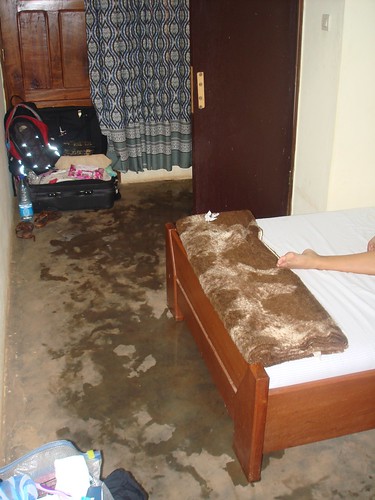 managed to turn itself on and began flooding our room! After we realized what was happening, turned off the water, and convinced ourselves that there was no such thing as a shower ghost, we decided to do our ‘laundry’ (after all, we were already wet and at this point in the trip, our clothes were really starting to smell).
We figured we couldn’t make anymore of a mess, so we proceeded to fill a bucket with soap and water. Somehow however, we managed to turn the small puddles that had gathered under our beds into what seemed like a full on river running across the room - It was quite a scene. Once we had done our best to get the dirt and stains out of our clothes, we hung everything to dry. Because we had been warned about bugs nesting in our underwear, the mental picture of which was fairly disturbing, we decided to hang our laundry inside our room rather than outside on the patio. We enthusiastically began what we called our “installation artwork”, which basically consisted of a tangled clothing line, crisscrossing over
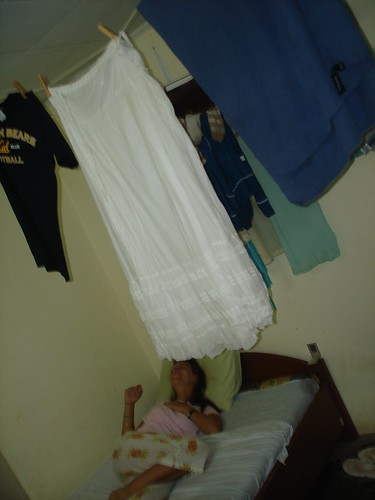 our beds. It took us an inordinate amount of time to figure out how to hang everything so that our clothes wouldn’t drip over us while we slept. But once we had finished, we were pretty proud of our contraption.
The following day we left early in the morning and were excited to return that afternoon to clean clothes. That is until we actually came back to find that although our clothes no longer smelled like the body odor of ten different people mixed together, they did reek of mildew - the stench of which is far worse when you are not use to it. Not to mention, everything was just as wet as it had been the night before. After we were told that we could use an iron to kill any bugs that decided to take shelter inside our clothes, we quickly moved everything outside. It was hilarious watching us iron - I have never seen people so intent on ironing every inch of their pants and paying special attention to the crotch…
…A laugh much needed - I guess there’s even beauty in doing the laundry.
Monday, September 17, 2007
Leaders of Today
In a country with leaders like Scott Sullivan (World Com), Jeff Skilling & Ken Lay (Enron), Barry Bonds (MLB), and Dick Cheney & George W. Bush, it makes me wonder; in what direction will the ethics of this country take in the next couple of years? Some would say in response to the list of leaders, that our future doesn’t look very bright - that today’s youth are learning from successful con artists. Others assert that it doesn’t matter anyway, because today’s youth are apathetic at best when it comes to political and social progress. This presents a problem when youth are supposed to become, and often addressed as, the leaders of tomorrow. But maybe society is focusing too much on youth as leaders of tomorrow instead of recognizing them as leaders of today (Pat Wu).
After spending the last two weeks reviewing 148 student applications for only 10 available non-profit consulting positions, I have been reassured that not all of today’s youth have become apathetic nor have their values been tarnished by the examples set by the aforementioned leaders. In fact, I have never been so inspired by my peers and the changes they aspire to make in both our immediate community as well as in the world. It says something when a non-profit consulting group is one of the most greatly demanded student groups on campus. Just like it says something when today’s youth are excited to dedicate 10-15 hours a week to pro-bono consulting for non-profit organizations.
The Berkeley Group (TBG) started in 2003, when five UC Berkeley juniors, after taking a business ethics course with Professor Alan Ross, wanted to do something more with the knowledge they were learning about business. They came up with an idea that would provide students an opportunity to gain business-consulting experience, while simultaneously giving them a chance to collaborate with non-profit organizations in order to help the community progress towards social change. TBG first began as a small group of students working on a single project. Over the past 4 years however, TBG has grown exponentially and has consulted for over 36 non-profit organizations in the Bay Area. Organizations such as The American Cancer Society, The National Sexuality Resource Center, Loco Bloco, The Women’s Cancer Resource Center, Inner City Advisors, and Women's Initiative for Self Employment.
The idea behind The Berkeley Group is that non-profit organizations “dynamically create a society in which individuals address the challenges of the environment, accept all members of society, and empower communities through education”. However, with such large visions, these individuals do not always have the time or knowledge to evaluate their organization and the effectiveness and efficiency of their work. Even if they do recognize a problem, there are few available resources to help determine how to solve these business-related issues. This is where The Berkeley Group comes in. As university students, we use our resources, knowledge, and passion, to work with individual non-profits to create solutions to the challenges they face. In short: The idea is, “Give a man a fish; you have fed him for today. Teach a man to fish; and you have fed him for a lifetime.” TBG helps non-profits help the community.
While students could be participating in a number of different activities on campus, it is obvious to me by the sheer amount of interest in the group, that students have a great desire to make a long lasting, sustainable impact. In my opinion, these are the leaders and the examples that society should be looking to. I have a friend who often jokes that TBG actually stands for “The Beautiful Group”. While most people usually laugh when she says this, I have come to agree with her. The Berkeley Group is a group of students with visions and passions who are refusing to wait for tomorrow to come. Student who are instead, actively choosing to become the leaders of today – pretty beautiful if you ask me.
Email The Berkeley Group at theberkeleygroup@gmail.com or visit our website at tbg.berkeley.edu
After spending the last two weeks reviewing 148 student applications for only 10 available non-profit consulting positions, I have been reassured that not all of today’s youth have become apathetic nor have their values been tarnished by the examples set by the aforementioned leaders. In fact, I have never been so inspired by my peers and the changes they aspire to make in both our immediate community as well as in the world. It says something when a non-profit consulting group is one of the most greatly demanded student groups on campus. Just like it says something when today’s youth are excited to dedicate 10-15 hours a week to pro-bono consulting for non-profit organizations.
The Berkeley Group (TBG) started in 2003, when five UC Berkeley juniors, after taking a business ethics course with Professor Alan Ross, wanted to do something more with the knowledge they were learning about business. They came up with an idea that would provide students an opportunity to gain business-consulting experience, while simultaneously giving them a chance to collaborate with non-profit organizations in order to help the community progress towards social change. TBG first began as a small group of students working on a single project. Over the past 4 years however, TBG has grown exponentially and has consulted for over 36 non-profit organizations in the Bay Area. Organizations such as The American Cancer Society, The National Sexuality Resource Center, Loco Bloco, The Women’s Cancer Resource Center, Inner City Advisors, and Women's Initiative for Self Employment.
The idea behind The Berkeley Group is that non-profit organizations “dynamically create a society in which individuals address the challenges of the environment, accept all members of society, and empower communities through education”. However, with such large visions, these individuals do not always have the time or knowledge to evaluate their organization and the effectiveness and efficiency of their work. Even if they do recognize a problem, there are few available resources to help determine how to solve these business-related issues. This is where The Berkeley Group comes in. As university students, we use our resources, knowledge, and passion, to work with individual non-profits to create solutions to the challenges they face. In short: The idea is, “Give a man a fish; you have fed him for today. Teach a man to fish; and you have fed him for a lifetime.” TBG helps non-profits help the community.
While students could be participating in a number of different activities on campus, it is obvious to me by the sheer amount of interest in the group, that students have a great desire to make a long lasting, sustainable impact. In my opinion, these are the leaders and the examples that society should be looking to. I have a friend who often jokes that TBG actually stands for “The Beautiful Group”. While most people usually laugh when she says this, I have come to agree with her. The Berkeley Group is a group of students with visions and passions who are refusing to wait for tomorrow to come. Student who are instead, actively choosing to become the leaders of today – pretty beautiful if you ask me.
Email The Berkeley Group at theberkeleygroup@gmail.com or visit our website at tbg.berkeley.edu
Friday, September 7, 2007
Opportunity or Tradition?
On my flight from New York to Paris (en route to Douala), I sat next to a Man from Mali making a living selling African artwork in a New York based gallery. As he pulled out a primitive looking, wooden figure from under the seat in front of him, he explained how these sculptures had been passed down in families, from generation to generation for literally thousands of years. Talk about tradition. He told me about his wife, whom he quickly informed me he had ‘chosen himself’, meaning his marriage had not been arranged. He was part of the “new generation”. His father went to college in Paris and although his father’s marriage was arranged, he wanted his son to have a choice. His father was what he called a “forward thinker”.
We began discussing why he left Mali and how he had come to live in Paris and do business in New York. He described the “lack of opportunity” in Mali and began to recount his brother’s experience: His brother, who had studied economics, was offered a job in the U.S. working for the World Bank. Once his brother returned to Mali, he was given a ministerial position in the government. After experiencing the American systems, however, there were many things in Mali that he wanted to change. “The president didn’t agree, so my brother lost his job.”
He expressed how difficult it is to find a job in Mali, and even when you do, it can be taken away without a justifiable reason. I understood why he and his brother wanted to leave Mali, but I silently wondered, “what is it that makes them want to return?” Before I could ponder the question for too long, it was inadvertently answered - we began talking about children. Although he doesn’t have any yet, when I asked where he would raise a family, he unequivocally answered that his children would live in Mali by the age of 10. I was confused. I thought there weren’t enough opportunities. Why would he want his children to struggle the way he had? He explained that while he absolutely loves America and the opportunities available, it is the tradition that is most important to him. The family tradition. The “African way”.
At the time, I’m not sure I understood his words. When is tradition more important then opportunity and work? But after spending only two weeks in Cameroon, it is clear to me, what he meant by the “African way”. So much of African culture is deeply rooted in traditions. Tradition is who you are, where you come from, and to some extent where you are going. Opportunity, your job, is only what you do. So what if you have to choose? How do you decide which is more important? Success and opportunity or tradition?
In Cameroon, I met a young man, Jonas, on a bus from Bamenda to Buea. He had spent the weekend in Bamenda with his family and was returning to Buea for school on Monday. He was studying for most of the daylong bus ride - Biochemistry. He wants to go to medical school to become a doctor in America. Why America? I knew the answer before I asked the question - To “make money so he could support his family”. Would he come back to Cameroon? Of course. Not only does he want to help his family, he wants to serve the people in the country he loves. While Jonas ultimately wants to live with his family in Bamenda, he said it would be easier to find a job and make money in America.
In the U.S., for most, education can be directly converted into a job, which is then translated into money. In Cameroon, it’s not so simple. Educating yourself does not guarantee you employment. The unemployment rate in Cameroon is around 30% (2001 est.) and a large portion of those unemployed have college level degrees.
I realized, it’s not either opportunity OR tradition, it’s opportunity so that tradition. It’s about doing whatever you have to do to keep your family, your country, your tradition, and therefore yourself, alive. This not only solidifies my conception of African strength and resilience, it explains how tradition plays a large role in the development of these qualities.
Winston Churchill said, “A love for tradition has never weakened a nation, indeed it has strengthened nations in their hour of peril.”
We began discussing why he left Mali and how he had come to live in Paris and do business in New York. He described the “lack of opportunity” in Mali and began to recount his brother’s experience: His brother, who had studied economics, was offered a job in the U.S. working for the World Bank. Once his brother returned to Mali, he was given a ministerial position in the government. After experiencing the American systems, however, there were many things in Mali that he wanted to change. “The president didn’t agree, so my brother lost his job.”
He expressed how difficult it is to find a job in Mali, and even when you do, it can be taken away without a justifiable reason. I understood why he and his brother wanted to leave Mali, but I silently wondered, “what is it that makes them want to return?” Before I could ponder the question for too long, it was inadvertently answered - we began talking about children. Although he doesn’t have any yet, when I asked where he would raise a family, he unequivocally answered that his children would live in Mali by the age of 10. I was confused. I thought there weren’t enough opportunities. Why would he want his children to struggle the way he had? He explained that while he absolutely loves America and the opportunities available, it is the tradition that is most important to him. The family tradition. The “African way”.
At the time, I’m not sure I understood his words. When is tradition more important then opportunity and work? But after spending only two weeks in Cameroon, it is clear to me, what he meant by the “African way”. So much of African culture is deeply rooted in traditions. Tradition is who you are, where you come from, and to some extent where you are going. Opportunity, your job, is only what you do. So what if you have to choose? How do you decide which is more important? Success and opportunity or tradition?
In Cameroon, I met a young man, Jonas, on a bus from Bamenda to Buea. He had spent the weekend in Bamenda with his family and was returning to Buea for school on Monday. He was studying for most of the daylong bus ride - Biochemistry. He wants to go to medical school to become a doctor in America. Why America? I knew the answer before I asked the question - To “make money so he could support his family”. Would he come back to Cameroon? Of course. Not only does he want to help his family, he wants to serve the people in the country he loves. While Jonas ultimately wants to live with his family in Bamenda, he said it would be easier to find a job and make money in America.
In the U.S., for most, education can be directly converted into a job, which is then translated into money. In Cameroon, it’s not so simple. Educating yourself does not guarantee you employment. The unemployment rate in Cameroon is around 30% (2001 est.) and a large portion of those unemployed have college level degrees.
I realized, it’s not either opportunity OR tradition, it’s opportunity so that tradition. It’s about doing whatever you have to do to keep your family, your country, your tradition, and therefore yourself, alive. This not only solidifies my conception of African strength and resilience, it explains how tradition plays a large role in the development of these qualities.
Winston Churchill said, “A love for tradition has never weakened a nation, indeed it has strengthened nations in their hour of peril.”
Subscribe to:
Posts (Atom)