Showing posts with label Ghana. Show all posts

Friday, May 29, 2009

E waste. aka Agbogbloshie. aka "wo ho ye fe paa"

My last and lasting memory from Ghana... (links to e-waste info, news, and video at the bottom)

Sunday, December 14, 2009

It was the day before our flight back to the US and Miriam and I had one last adventure ahead of us. She had read about an E-waste scrap yard, aka dumpsite, in Accra and wanted to see if we could find it. We once again jumped in the back of a trotro, not really having any idea where we were headed, but as usual people we met on the way pointed us in the right direction. We went from one trotro station to the next, finally figuring out which one had cars that would drop us off near the waste site. We told people we were trying to get to Agbogbloshie – the name of the scrap yard (yeah, try saying that three times fast!). We were directed to a trotro in the far corner of the station. It was a trotro unlike any other I had ever been inside. The doors opened in the back of the van and there were no windows and no way to communicate with the driver. There were benches rigged to both sides of what felt like the back of a cargo container. The van was full except for one seat. We had no idea when the next car would come so we told the mate that we could make it work. He seemed slightly amused as he watched Miriam and I climb over the other passengers and squeeze ourselves into the tiny space left in the middle. Their faces changed from confusion to surprised approval as I sat down and motioned for Miriam to sit on my lap.

Once we were on the road, I finally had a chance to survey the other people in the car. There was a man in long pants and a tattered dress shirt, an older women with crocked teeth smiling at us, a baby strapped to the back of its mother – head bobbing up and down with the movement of the car and of course a number of beautiful women. There was one woman in particular that I literally couldn’t take my eyes from. She was breathtakingly beautiful. She wore a typical full length Ghanaian dress, tight around her hips and flared at the ankles. Her head was covered with a piece of matching cloth tied up and knotted around her hair. I remember thinking that she looked so calm and glamorous sitting in the back of that car. I imagined where she was going – it wasn’t Sunday so it couldn’t have been church. A party? Maybe a wedding. Ya, that’s it, a wedding. The trotro came to a stop and brought my daydreaming to a halt. One by one we filed out of the van, thankful for the fresh air. Now what? We had no idea where we were going and we weren’t exactly sure how to tell people we were looking for a waste site. We decided to wander. We walked only for a couple of seconds before we noticed trash piled alongside the road. I glanced across the street at what looked like a river of sewage lined with trash and metal parts. We had found it.
We walked into the scrap yard – a mixture of dirt and broken computer parts under our feet. The smell of burning trash and plastic welcomed us. We were both in sandals. Maybe I should have worn shoes? A little boy running around with bare feet interrupted this thought. There were broken motherboards and CDs, discarded bicycle frames, refrigerators, broken cars, rusting piles of metal, and rejected ovens and computers. We walked past a group of young men behind a gated off section of the yard. The sound of hammering and work stopped as they saw us approach. A couple of the braver ones came running out to greet us. I wasn’t sure how we were going to be received – as foreigners? intruders? I should have known we would be treated like friends. We couldn’t communicate with words and as we held out our hands to greet the young men, they hesitated. One of the men showed us his palms – they were covered in filth from working with the scrapes and wires. My heart sank a little as I glanced at my own perfectly Purell-ed hands. He didn’t want to get them dirty with his own. Instead they smiled and waved as we continued further into the yard.

The river of sewage seemed to separate the site into two parts: the side on which the e-waste was dumped and kept, and the side on which the people live. On the side opposite of where we stood, shanties lined the ‘river’. People actually live here. Raised their families here. This was their backyard. We noticed a small makeshift ‘bridge’ (slats of wood) connecting one side to the other. As we got closer, another group of young boys motioned for us to follow them across. Needless to say we both hesitated, imagining ourselves falling in the smelly river of human and manmade waste. We carefully balanced on the first board. One of the boys looked back and said encouragingly “It’s okay. Go small small” translating into take it slow, one step at a time. We made it across the bridge and climbed up the edge of the embankment. We walked along the front of the shanties. Some images that stuck with me: a small boy defecating on a pile of burned trash, a group of women sitting around a table playing a board game, a little girl rummaging through a mound of waste – a red streamer around her neck.

We walked past a group of men and women sitting on a bench. To my amazement one of them was the beautiful woman from the trotro. I was shocked to see her in her stunning dress and jewelry sitting in the middle of the scrap yard. She motioned for us to come and join them. We sat down on the bench and spent the next couple of minutes trying to remember as much Twi as we possibly could. After we ran out of greetings I clumsily blurted out “Wo ho ye fe paa” – you are very beautiful. The women smiled and blushed. Her friends laughed but agreed. We waved goodbye and continued on. There was a large truck overflowing with men and flags – red, white, back, and green. The sound of a bullhorn told us it was part of an NDC rally (the presidential election was still going on at this time).

I’m not sure what I had expected, but as we walked through this waste town I felt more and more confused. I couldn’t see the toxic chemicals, the chlorinated dioxins, or the phthalates that were slowly poisoning these people. All I could see was life. People doing the best they can with what they have. People welcoming strangers into their home. I don’t know when in my mind these people whom I had heard about, burning electronic cables, started being casualties instead of people. While Miriam and I walked out of the scrap yard I made a promise to myself: No matter how awful or unfair someone’s situation, no matter how hard people fight and fail to change it, never again will I assume that a person is a casualty, a victim, or a martyr. Never again will I assume that a person is anything less or different than a human being living his life the best way he knows how.

I am reminded of my Cameroonian friends Flynn and Brian and how they didn’t know me, but they took care of me. “You are my sister and I am your brother” was the only possible explanation I received or needed. Reflecting on this almost two years ago, I wrote, “We are family because we are human beings - we share a world, a history, and a vision.” Today I am a little more pragmatic and maybe a little less naïve. I have such mixed feelings on what actions foreigners, especially westerners, should take in order to “Save Africa” (See previous post). However, I do hope that someday we can stand up to the electronic companies in developed countries that are poisoning Ghanaians in Agbogbloshie, not because they are helpless victims, but because they are people, which make them family.

For more information:
Download full Greenpeace document here
Ghana's growing e-waste trade, BBC
UK's e-waste continues to be dumped in Ghana, Nigeria despite public outcry, Ghana Business news

More videos

Do you do voodoo?

Saturday Dec. 13, 2008 (cont.)

Miriam and I had heard that there was a Voodoo market in Accra. Some of our friends had even tried to find it a couple of time. There was apparently a voodoo section at the “Timba market” in Jamestown. Without thinking too much about it, we decided to ask around and see what we could find. The man who led us to the top of the lighthouse pointed down the main road leading through Jamestown. We asked if we could walk but he told us the market was too far – we needed to take a cab. But we felt empowered after visiting the slum fishing village and decided to at least walk as far as we could. We strolled down the road getting lost in deep conversation (a definite theme when we are together). We asked a couple of friendly faces if we were headed in the right direction. Before we knew it a women had offered (through a third party since she didn't speak English) to take us there.

She walked quickly. Miriam and I must have looked like two straggling ducks trying to keep up with their mother. The women looked back at us every so often to make sure we were still behind her. She stopped in front of a dirt area connecting two larger buildings that faced the main road. There was a tall wooden fence between the buildings and a couple of cars parked in front. She motioned with her hand that we should follow her. I looked at Miriam confused and uncertain. She motioned again and disappeared through a small cutout in the wooden fence. As we got closer we could see the sign hanging above the cutout doorway. “No trespassing. Violators will be prosecuted.” Miriam and I shared another quick glance and a mischievous smile. One after the other we ducked through the doorway and hurried to catch up with the woman who was quickly gliding through the small passageways.

It was the most astonishing thing – there was a whole market community behind that fence. We walked through the narrow dirt paths that were lined by wooden stands. People were selling everything a person could possibly need. Our curiosity couldn’t keep up with our legs. We thanked the women for her help and said goodbye. We were on our own, completely lost in the middle of the market. We figured we would start asking around about the supposed voodoo section. We weren’t quite sure how to ask someone if they knew where we could find gigi charms? Did they even call it voodoo? Would that be offensive? We were surrounded by bags of nuts and bolts - the home depot of Accra. The men were eager to help us find whatever we were looking for. I got the feeling it wasn’t every day that two oburoni women came to visit. After the appropriate greetings and a little bit of flirting, we tested the water – “do you know where we can find voodoo?” The men looked at each other, thought for a moment… “Medicine. You are looking for medicine. Follow me” Before we knew it we were off and clumsily chasing another graceful Ghanaian who had probably grown up weaving in and out of market passageways (I almost got knocked out multiple times by men carrying wood on their heads). As we moved through the market there was a buzzing sound that kept getting louder and louder - the sound of electric saws cutting wood. There was sawdust everywhere, the cutting of Timber. All of a sudden it made sense… “Timba Market” = Timber Market.

We finally reached the section of the market we had been looking for. Skins, bones, hair, bark, shells, coins, and wooden dolls were hung and stacked high inside the stalls. We couldn’t believe that we had actually found it. We walked around and stopped at a stall owned by a woman named Mercy. She explained what everything was used for. She explained how to use coins and red string to make wishes, which dolls were used for fertility, and how to get rid of illnesses. By asking questions, we learned that generally speaking, everything could be used for anything. I asked Mercy what was used for love. I bought some dried up seedpods that are supposed to be brewed into tea and given to a lover - the perfect wedding gift for my sister. We had such a fun time looking around and talking to the vendors. We found our way out of the market. Sitting in the back of a cab as it drove away, we knew we would never be able to explain where the market was located. We probably couldn’t even find it again ourselves. As we recapped the events of the day, I realized once again that it was not just the destination that was inspiring; it was the entire journey.

love from Tustin.


The voodoo section of the 'timba market'

Miriam and Mercy

Monday, May 4, 2009

A day to last a lifetime in the Jamestown slum

Saturday Dec. 13, 2008

The last time we were in Jamestown was during the first week of orientation. We toured Accra in an air-conditioned charter bus – it could barely fit through the streets on the outskirts of Accra’s largest slum town. I remember sitting with the side of my face pressed up against the window watching life go by. Women hanging laundry – torn and tattered yards of fabric to dry. People cooking over open fires – black smoke dancing with the trash and dirt picked up by the breeze. I remember seeing a small schoolgirl in a blue and yellow uniform trip and fall – scattering her books in the street. I was an observer that day – removed from the emotions, passions, and monotony of every day life in the Jamestown slum. We weren’t allowed to get out of the bus and even if we had been I’m not sure if I would have been able to shed my bystander skin. After spending almost 5 months in Ghana, I had learned there was a significant emotional difference between observing and engaging.

Miriam and I decided that with only a couple days left in Ghana it was time for us to go back to Jamestown and explore a part of Accra we had not yet seen. We took a tro tro to Jamestown and wandered around until we found the Jamestown lighthouse (one of the landmarks mentioned in the tour guide). We ran into a man that said he had keys to go to the top. It looked closed, deserted even – except for a group of small kids playing a game of foosball right in front. But we followed him anyway. Sure enough our new friend found the woman in charge. After collecting her fee, she let the man lead us to the top of the lighthouse. What a view.

We could see all the way down the main road and the shanties by the water. A strange juxtaposition – the small confined spaces enclosed with scrap wood and metal. The infinity of the ocean. After observing from the sky, we agreed it was time to engage on the ground. We decided to walk around the slum fishing village right on the water. Everyone stared as we stepped over fishing nets and under hanging sails and tarps, moving further into the heart of the small fishing community. It was uncomfortable and not all of the stares were friendly. I felt out of place and a bit nervous. I couldn’t tell if it was because of my prejudices or theirs. Probably both. I was entering a world i will never completely understand with a life and a background they too do not know. I tried to escape my prejudices and my differences. I smiled at the men repairing the nets and made small talk with the women we passed. Wo ho te sen? Ye fre me Abeena. Once again our limited amount of Twi served us well. I began to feel the tension between my shoulders slowly disappear.


It was as if the more relaxed I became, the friendlier the people treated me. Word spread that there were Obrunis in the village speaking Twi. Before we knew it we were in the middle of the small slum village and approaching the peer. We asked the group of men sitting near by if we could walk on it and “come right back”. They laughed and smiled. Permission granted. Once again we dodged piles of nets, distracted by the young men running and jumping off the small wooden peer. They did flips and tricks, each one flashing a smile before catapulting their naked bodies into the air. We sat on the edge with our feet dangling over the water. Some boys our age came to chat with us. I was no longer uncomfortable or nervous. It constantly amazes me what a smile and an open heart can do.

After about 15 or 20 minutes an older man came over and explained that women were not allowed on the peer. Miriam and I looked around and then at one another. There wasn’t another female in sight. Oops. There are two important things that are relatively easy to forget but that we will never be able to escape: We are white and we are women. We apologized, said goodbye to the boys and left. As we walked out of the slum people smiled and waved. Yebeshia Bio - We will meet again soon. Despite the unlikelihood that their greeting would hold truth, there was warmth in their smiles and sincerity in their eyes.

love from Berkeley.

Sunday, February 22, 2009

It's a small world after all.

Continued...

He was short with dark dreaded hair to his chin. A metal marijuana leaf hung around his neck on a beaded chain - red, yellow, and green – the colors of Ghana, formerly known as the Gold Coast (red to remember the blood that was shed, yellow for gold, and green for the natural resources and land). It wasn’t so much the “rasta” look that gave him away or even the dimples that complemented his wide smile. It was more of an attitude. An aura. He seemed comfortable, at ease, almost like he owned the place. He introduced himself. “Ye fre me Ablo” (They call me Ablo). “It's nice to meet you Ablo. By any chance to do you know Aruna?”

Aruna was our Kora teacher. He came to Legon on Sundays and sometimes we would go to Kokrobite, where he lived, to see him perform. Turns out Ablo is who Aruna has been talking about for the past two months. Ablo lets Aruna stay with him in Accra after he finishes with his lessons in Legon. “Aruna is my brother.”

Ablo and Miriam after a beer in the village bar

Ablo insisted on showing us around. We followed him through the village and the adjacent dumpsite – hiking over mounds of dirt and trash. He lived just on the other side of the lot. We approached a small one-bedroom hut – no furniture, only a floor to sleep on and a stereo for listening to music. A section of the wall was lined with glossy photos of musicians, handmade Koras, foreign students, and friends. A tall man sat on a bench outside the hut. Wooden slats and small gourds surrounded him while he diligently worked on a xylophone. Building it from scratch.

The village behind the art center

View from Ablo's hut

Before we knew it, we were enjoying our own private concert. Drums. Kora. Xylophone. Voice. A couple people gathered to watch. Three young boys wanted in on the action – jumping around and being silly – trying to steal the attention from the band. The three men played their hearts out. You could actually feel the passion – the blood running though the instruments they had taught themselves to play. The sun began to set. With one last inhale and look around, it was time for us to go home.


Ablo and his friends jamming


The fans

More last and lasting impressions to come soon. In the meantime,
Love from Berkeley.

Sunday, February 8, 2009

Accra Adventues

“Kcra, Kcra, Kcra”

This is what the trotro mate, (the driver’s wingman – so to speak) while hanging out the side of the van, yells when passing by a station so that people know he is going to Accra.

We only had a couple days left in Ghana and for the past week we had all been trying to figure out how best to use them… Can we get all the way up to Burkina Faso? Can we make it to mole national park in the north? How crazy would we be to go to Cote d'Ivoire? We finally decided that to go anywhere far away would just be too much. Besides, we had lived in Accra for four and a half months and we had still so much of the city to see. So Miriam and I set off to the center of the city – not having a plan and barely a destination. But the places we went, the people we met, and the things we saw… well, I wouldn’t trade them for anything. And so, here they are, my last days in Accra, the Accra adventures – the lasting impressions…

Thursday, Dec. 11, 2008

Miriam and I had both been to the art market near Tema station before. It’s a tourist trap. A place where you can buy Kente cloth without ever visiting Kumasi, overpriced drums and figurines, masks that have never been worn, and swords of all kinds. As soon as you step into the dirt parking lot you are bombarded with offers. People from all directions swarm to you with their beaded jewelry and instruments. Although the market is well done - each vendor has their own stall under a high, wooden roof – it is still intimidating.

We got off at the Tema Trotro station and started walking. We couldn’t remember exactly where the center was, but we decided to follow our noses until things began looking very unfamiliar. We stopped to ask for directions from an older man who spoke very little English. He understood “art center” and our hand gestures of drums and paintings. He spoke quickly and pointed with both hands. Left then right? Right then left? Follow which road? He could see the confused expressions on our faces. We started to laugh and he motioned for us to follow him. In typical Ghanaian fashion, he walked with us until he could point us in exactly the right direction and then turned back and continued along his own path.

We made it to the market unscathed and began our search for small brass weights. We had bought a children's book that explained how and why these small figurines were made and wanted to find some of the small weights to go with the book. We worked our way to the back of the market and settled on a small stall where we could practice our Twi negotiating skills.

“Me pe baako” – I want only one. “Oh me adamfo. Te so” – Oh My friend. Reduce the price. The awura (seller) laughed at our broken use of his language, impressed at our knowledge. And so the bargaining began. He gave us a price. “Ahh (it’s important to pretend to sound shocked) Dabbi Dabbi Dabbi” – It’s too much. Too expensive. We gave him a counter offer. “Oh my sister’s 5 cedi? It’s no good. No good. 10 cedi is good. 5 cedi is no good.” We finally settled on a price for our small figurines, laughing and joking the whole time.

“What about some ‘giggy giggy’?” He pointed to the small statues of men and women in compromising sex positions. Miriam and I looked at one another and started to laugh. “what? You no want giggy giggy? I give you good price”. “My brother” I replied, “giggy giggy to so” - ‘to so’ is one of the most important expressions. It literally translates into ‘add a dash’. For example if you are buying 10 tomatoes and say ‘to so’, the seller will usually add a couple extra free of charge. He started laughing and couldn’t stop. I don’t think anyone has ever asked him to add a dash of ‘giggy giggy’. We waved goodbye and kept working our way to the back of the market.

The farther back we went, the more friendly and easy going the people seemed. There was less pressure to buy things and we weren’t noticed quite as much. People were busy chatting and working away. We made it to the last stall in the back. It lined a dirt trail that continued behind the market area. We kept walking. Before we knew it, we had entered a small village-like community. Who knew there were people living behind this popular tourist destination we had been so many times before? There were small doorless shacks with people building drums, a tiny bar where a group of men where having drinks on plastic chairs. There was even a soccer game going on right on the edge of the bluff with a beautiful view of the ocean. This next to a huge trash dumping ground to our left and a couple of chickens and goats running around. We just stood there for a minute in awe of our surroundings.

Right in front of us there was a group of about 5 children between the ages of 3 and 7. They were forming a line for something. Then, in an instant, one of the older children raced buy us, pulling an old beaten up suitcase behind him. The top flap had been torn off so that it was no longer a suitcase but a wagon. Sitting inside the wagon/suitcase was a small child no older the four. Sitting on her knees and holding on to the sides of the suitcase - hanging on for dear life. Smiling from ear to ear. The other children were lining up to be pulled in the suitcase. They whizzed back and forth in front of us, taking turns pulling and being pulled - Laughing all the while. It’s one of those images that will be forever burned in my memory. Wherever you go, kids will always be kids.

After walking around a little more, saying hello to all of the people, showing off our Twi, we began to head back to the art market. We walked by a young man who looked uncannily familiar. “Doesn’t he kind of look like Aruna?” Miriam asked. “That’s funny. I was just thinking the same thing.” It wasn’t Aruna. But it was his best friend. Someone we had heard much about, but never met.

To be continued…

Monday, December 15, 2008

It's a bitter sweet symphony...

Today is my last day in Ghana. I woke up at 5:15am and ran up commonwealth hill one last time to watch the sun rise. it was beautiful.

The next 13 hours will be spent running last minute errands and saying "yebeshia bios" (we will meet again soon), to friends and family.

My flight leaves from Accra tonight at 11:30pm and arrives in London about 7 hours later. The last week in Ghana has been full of adventures which im excited to post about during my layover at Heathrow airport.

Thank you for all of your love and support during the last 7 months of travel.

Just wanted to say one last time...

Love from Accra!

Elections in Ghana

I can't believe i haven't written about the election yet...

The 2008 Presidential election took place in Ghana on Sunday Dec. 11. The weeks up until voting day were filled with political rallies all over the country, including rallies at the University of Ghana campus. It was (and still is) the topic of discussion on trotros, at chop bars, and in Taxis.

Everyone wants to know "Are you moving forward (NPP) or do you want change (NDC)?"

While there was some incidents of violence during voter registration, the election on the 11th has been declared by both Ghanaians and outside observers as peaceful and fair.

Ghana's Electoral Commission has announced the presidential polls will go into a run-off on December 28 between Nana Akuffo-Addo and John Atta Mills .

The certified results from 229 constituencies announced by the EC credits the New Patriotic Party (NPP) candidate, Nana Akuffo-Addo 4,159,439 polls representing 49.13 % of votes cast,

The opposition National Democratic Congress (NDC) contender John Atta Mills is behind him with 4056634, representing 47.13%

The run off vote on the 28th was met with both excitement and disappointment. Tension is still running high and it is expected to increase over the coming weeks leading up to the vote.

BBC World Service - Ghana Elections 2008 reports on Ghana's election and the upcoming vote on the 28th of December 28th.

Will be watching from the U.S. :)

Thursday, December 11, 2008

Much to be thankful for

Cooking thanksgiving dinner in Volta Hall's main cafeteria...
We call it Ghanaian/ American fusion


"Ehh!? You are cooking green beans? Oburoni Why?? All the nutrients will leave them!!?

"but Auntie Ester, that's the whole point of thanksgiving - to cook the nutrients out of everything!"
...
The Cooks

"Ugh! Dabbi! Dabbi! (No! No!)"

"What's wrong Auntie Joyce?"

Auntie Joyce sticks her finger in the canned cream of mushroom soup. She makes a face.

"Ugh! Daabi! Daabi! I cannot eat this!"

"It's okay Auntie Joyce. This is Oburoni cooking. It's supposed to taste like that."
...

Six of us volunteered to help cook thanksgiving dinner. Elizabeth, one of our EAP coordinators, dumped about 10 loafs of bread in front of us. "You can make the stuffing". Anita and i looked at each other and then back at Elizabeth. "I don't suppose you have a recipe do you?" Right. Didn't think so.

We used our imaginations, tried to remember what we've seen in our own kitchens, and well... we faked it. At one point i asked for a measuring cup. "Measuring? What do you need a cup for? Use your hands".

Despite missing family at home, it was an awesome thanksgiving. Great food (i think we ate the only four turkeys in Ghana), Great music - drumming and lots of dancing. Great friends.
...

We found out about the Mumbai attacks on thanksgiving morning.

"Crises and deadlocks when they occur have at least this advantage, that they force us to think." ~ Jawaharlal Nehru

Thinking about friends and their families in India.

Love from Accra.

Tuesday, November 25, 2008

Togo Pictures


Beautiful beaches of Togo (just past the border, near Lome)

View of Cathedral from the Grand Marche in Lome
Clay pots in the Friday market in Vogan


In the market

Checking out the Voodoo section... Skulls, Teeth, Skins oh my!

Love from Accra!

Sunday, November 16, 2008

Adventures in Togo and Benin

As usual, a lot has happened since my last post. For one thing, school has ended and finals are beginning. Exactly one month from today I will be on my way back home to California. Part of me is of course sad to leave, while the other part can’t wait to be back on Zig Zag for a while. But, I still have 4 more weeks of adventure. Speaking of which, I am excited to finally write about my trip to Togo (the country bordering Ghana to the east) and Benin ( to the east of Togo).


October 24th …

We (Miriam, Rebecca, Liberty, Matt, Kevin and I) arrived in Togo on Wednesday evening after a full day of travel, crossed the border on foot, and found a cab to take us to a hotel near Lome. Because it was dark, because we were tiered, and because our French was limited, we ended up paying 10 dollars to go 2 miles. “Well, it looked a lot further on the map” Rebecca consoled. At least we made it to hotel Le Galion, (which we would later refer to simply as “France” – because of the amazing food, the décor, and the attitude of the clientele). The next morning we woke up to the sound of rainfall and took a cab to the center of the capital city. Lome has a very different vibe than Accra. For one thing, it is much quieter. It lacked the kind of manic chaos that in my mind defines large capital cities. Right away I understood what the tour book had meant by “decaying colonial charm”. Togo obviously had at one point experienced a build up of infrastructure. A lot of buildings, roads, stoplights, and much fewer shanties, and shacks lining the roads. But everything we saw was old. Crumbling. Falling apart. Paint peeling. Metal rusting. It contrasted greatly to Ghana’s current development. Ghana is heading forward while Togo is slowly slipping backward.

After walking through Lome and checking out the cultural center, we spent some time at the Grand Marche (market). It was one of the more relaxed markets I have been to. No pressure. No cars. No foreigners. Only foot traffic. Women carried large stacks of clothe on their heads while men pushing carts full of produce or electronics. It began to sprinkle again and we found another taxi to take us to Togoville, the voodoo capital of Togo. The 6 of us squeezed into the tiny cab and arranged ourselves as comfortable as possible for the 1-hour ride from Lome – 4 in the back and 2 in the passenger seat.

We were dropped off at the edge of Lake Togo where we would have to get a canoe to take us across the lake into Togoville. We went for a quick swim in the beautifully calm lake and trekked through cornfields, houses, and mounds of dirt to get to the dugout, wooden boat. We crossed the lake at sunset and arrived in Togoville in the dark. The following morning, before we left for the Friday market in Vogan, we had breakfast – omelets – in someone’s backyard. We had been searching for something other than chicken and fish all morning. I’m not exactly sure how we ended up there, but before I knew it, three Togolese men were cooking us breakfast in the small dirt courtyard. They had arranged themselves under the metal overhang of a small, unremarkable house. a mango tree in the center with a clothes line connecting it to the mud brick building. The men took shots of gin while cooking our eggs.

The market in Vogan was truly breath taking. I have never seen a market as picturesque. Everything about it was beautiful. The colors, the people. It was so easy going. Crowded but manageable. Somehow it felt safe and calm. Women wearing large brimmed straw hats. No one really even noticed us (the only foreigners). It was as if they were too busy going about their normal activities that they didn’t have time to give us special and generally unwanted attention. There were people selling everything you could ever want (well, need). It was an outdoor market organized into sections – beads, livestock (goats, chickens, etc), fruits and vegetables, clothes, and then we came across the voodoo fetish section… It was like nothing I have ever seen. Live chameleons for luck. Skulls – birds, alligators, monkeys. Skins, bones, teeth, turtle shells. It was right in the middle of everything. Just another part of life in Togo in which -59% percent of the population have animist beliefs. The men invited us to sit down under their wooden awning to get out of the sun. They explained some of the fetish charms. Miriam and I ended up buying necklaces that were supposed to provide us with protection.

While we were exploring, we got separated from the boys. We found matt in the voodoo section, but couldn’t find Kevin and unfortunately our phones weren’t working. While walking around searching for the “tall obruni man in a bright pink shirt” we found a man with a bullhorn – preaching the gospel or trying to sell something (I couldn’t understand the French). Somehow Rebecca convinced the man to give her the bullhorn and she began shouting for Kevin. When there was no sign of him, she handed back the bullhorn. As we were about to walk away, the Togolese man decided to help us. He started yelling “Evan! Evan!” We all laughed and joined in trying to enunciate the K in Kevin. Before we knew it the whole market was laughing shouting “Evan! Kevin! Evan!” Man shouted. Needless to say, we finally found him.

After exploring the market, we decided it was time to head on to Benin. We got lucky and found a trotro to take us to the Togo/ Benin border. Comfortable but very bouncy. The driver was being kind of crazy, making sharp turns and passing other cars, reminding me of Indian driving. At one point, we were passing over a short bridge when our driver decided to overtake the car in front of us. Only there was another car coming in the opposite direction. Before I knew it we were facing a head on collision. On a bridge no less! I don’t know how we squeezed past the car at the last minute avoiding what could have been a very bad accident. Miriam and I looked at one another. “Maybe this voodoo stuff really does work” we decided, thinking of our newly purchased fetish necklaces. Finally we rolled to a stop near some a large group of trucks, not too far from the border. We had found out that the trotro break had gone out. I guess the driver had motioned to Matt during the drive that he couldn’t stop the car. Apparently, Matt suggested the emergency break. With an unease smile he indicted that the emergency break did not work either. “It is finished”. Upon hearing this, Miriam and I explained to the group how lucky they all were that we had bought or voodoo protection necklaces. However, I think the group consensus was that if the charms did actually have some kind of voodoo power, we wouldn’t have gotten into a brakeless trotro in the first place.

The trotro driver helped us find another car to take us into Benin. By this time we had crossed the border out of Togo, but had not yet passed the border to enter into Benin. Traffic at the border was awful. Jam packed. Bumper to bumper. We were at a complete standstill. The driver got out of the car in front of a restaurant bar. Becca had to pee and before I knew it we were all out of the car. After all, what was the point of sitting in a hot car when it wasn’t going anywhere? The boys ordered drinks while Miriam and I decide that we should at least watch to see when the traffic lightened up. We sat on the patio with a view of the car and started talking about the day. We got completely distracted until Becca came over and asked where the car was. Miriam and I looked up. It was gone. Shit. We ran to the side of the road and it was nowhere in sight. “I guess we will have to find another car”. Oh f*ck. “Our bags are in the car!!”. Shit. (at least I had my passport and valuables on me – Mom has taught me well J ). Miriam, Rebecca, and I ran through the street frantically searching for the white car. We caught up with the traffic, hoping that the driver couldn’t have gone too far. We found a security guard and in broken French tried to explain what had happened. By this time I was sure our bags were gone forever. He told us to calm down. “You don’t understand. We can’t calm down!” We kept running through the street. Dodging people and motorcycles as we ran. The vendors on the side of the road yelling at us. Found driver parked near the border with a bunch of other cars. Thank goodness. We all hugged him. Kevin, Liberty, and Matt found us with in 10 minutes. I guess everyone on the street was pointing them in the right direction – the direction the other obrunis were running. We paid the man, grabbed our bags, and crossed the border on foot. Before I could comprehend what had happened, we were in Benin.

To be continued…

Love from Accra!

Wednesday, October 29, 2008

Photos! End of Ramadan in nima

Pictures from the festival...


Miriam, Becca, and I. Ready for the festival.
(Yes we are wearing pants and scarves in 90 degree heat! crazy!)


Breaking of the fast. A day of sharing and eating...


Candidate for the NDC (National Democratic Congress),
John Evans Atta Mills, waves to the crowd


Togo and Benin adventures coming soon!!

Wednesday, October 15, 2008

Eid al-Fitr and the black stars

The past couple of weeks have quietly come and gone. I have been keeping myself busy here in Accra and making trips to other parts of Ghana since class takes up only a small amount of my time.. I have also begun playing the bamboo flute and the Kora (kind of like a guitar made with a calabash gourd). The days are full of mini adventures and at the end of everyday, someone always says, "Man. That was a strange day" so i guess strange has become the norm while living in Legon.

Two weeks ago marked Eid al-Fitr (the end of Ramadan and the fast).

On Tuesday, Rebecca and I went with Miriam to Nima (a predominantly Muslim town in Accra) to celebrate the end of Ramadan with the principal of the school where she is volunteering. Before heading to the street festival, we were invited to his mother's home to have lunch. We sat on a wooden bench in a dirt courtyard surrounded by small cement houses. In one corner of the courtyard was a goat pen constructed from left over scrap wood. An older man was sitting in front of the makeshift gate door, choping up food with a machete. In another corner sat a series of pots, which bubbled over with oils and juices, filling the whole courtyard with delicious smells. We were brought a huge bowl of rice and chicken with 6 spoons and were not allowed to get up until nothing but bones were left.

After walking around Nima a bit, visiting Kofi's family and friends, we walked to the street festival. It was similar to the parade in Cape Coast. The chiefs were carried down the street like royalty. They were raised high in the air and protected from the sun by large red umbrellas. Hundreds of peole filed in after with a sense of organized chaos. In true Ghanaian spirit, all the people were dancing as the followed the drummers down the street.

We also followed the crowd until we reached a big stage that had been set up for the event. I realized that everyone around us was sporting red, green, and black clothing - the colors of the NDC political party. A man whose body was painted like an NDC flag ran up on stage and started dancing. People were cheering. HOw did we get in the middle of a political rally? My initial trepidation was swept away in the excitement. Put in a trance by the chanting - "Youth, power, action". Part of me was completely alert to the fact that a fight could break out at any moment. There has been some election related violence in the northern part of Ghana, which has put the whole country on alert. A man in a pink polo shirt appeared from the sunroof od a black SUV. It took me a second to realize it was none other then the NDC presidential candidate just 10 feet away from me. He waved and smiled. Obviously a bit surprised to see the group of obrunis at the celebration. It was definitely one of the biggest crowds i have ever had to push myself through, almost mob -like. That is until i went to the black star match last Saturday.

The Black stars are the national soccer team. I traveled 5 hours to Takoradi on Saturday morning to watch them play Lesotho in a world cup qualifier. We arrived at the stadium about half an hour before the game was scheduled to begin. We didn't have tickets. We joined the huge crowd at the front of the gate waving money at the men scrambling behind the glass window. Before we could figure out what was going on, we heard someone say "They are finished" (a phrase we here often in Ghana). After hearing the same thing from other fans, security guards, and ticket holders, we were still optimistic. We had managed to buy one ticket off of someone else and were waiting around outside the stadium for some kind of divine intervention. Sure enough, we mwt a man who showed us how to get inside the walls of the stadium through a gate that had been unintentionally left open.

On the other side of the wall, we tried again to get tickets from security, but no luck. Just when we were about to lose all faith, we saw an official take money from a couple of fans. We ran back over to the glass window. About 30 other people running after us. I pushed to the front (thank goodness for my height), shoved the money through the upper slot in the glass. "Mepaakyew. Mepaakyew boss." The men inside the booth were once again scrambling while other fans tried to break open the door (and eventually succeeded). The man took my money and quickly handed me three more tickets. WHOOT WHOOT! What a rush. We were jumping up and down. We bribed the man collecting tickets to let us all go in the same section and somehow were able to find "seats" in the aisle.

We definitely had to fight to keep our pseudo seats on the steps. By the end of the game i was literally sitting in some Ghanaian woman's lap with another mans feet in my face (yes he had taken off his shoes!). People were hanging on the side of the stairwell and sitting on top of the roof. It would have been a really uncomfortable afternoon, but one of our friends had brought a waterbottle full of gin. We took shots everytime there was a shot on goal. So by the end of the first half, it didn;t matter that i was sitting on someone or that someone's coke had spilled on me or that some guys feet were in my face. By the end of the game i had a black star painted on my face, a flag tied around my sholders and a bandanna on my head. We were all having a great time. The whole staduim went wild everytime Ghana scored. jumping up and down. It was great! we won 3 to 0.

I'm travelling through Togo and Benin with some friends next week and then mom and dad will be here the following week.

Pictures to come soon...

Love from Ghana!


Friday, September 12, 2008

Cape Coast Festival - Gods, Priests, and Blood

Walking back in an awestruck daze, Rebecca’s high-pitched voice sang from behind me, “You have dirt on your shirt”. I stopped in the middle of the street, my back still turned to her, thinking about what I had just witnessed. The brush of her hand on my back woke me from the solitude of my reflection. The street was crowded with people, but less congested than it had been only a few minutes ago. We walked in the opposite direction of the decapitated bull, which was now being paraded through the town of Cape Coast on a rusting wooden wagon. “It’s not dirt” she said both disgusted and intrigued. “It’s blood”.

We arrived in Cape Coast on Thursday evening. We stayed in the Savoy hotel. The agenda for the night: To watch the fetish priests dance. It was late and I was tiered, but the town was excited – alive. Part of me wanted to fall asleep to the whooshing sound of the ceiling fan, the other part of me craved adventure and experience.

We walked through the streets of cape coast, towards the sea, in the direction of the cape coast castle. A row of ducks following our student leader at a pace no quicker than a slow meander. The streets were lined with people and stands – popcorn. small shops – hair weaves. clothing. cloth. Drinks and biscuits. Music blared. The horns of taxi cabs filled the streets along with the sound children calling out, “Obruni. Obruni” – A greeting that I now answer to on a regular basis. A name that I have taken as part of my own. We finally arrived at the sacred site where the dancing was to take place. It was an alleyway, only slightly wider than the two parallel roads it connected. On the corner was a small enclosed area, 15 by 15 feet, surrounded by a brick wall between five and six feet tall. A single tree stood proudly in the enclosed area, adding a hint of greenery to an otherwise filthy, garbage littered road. As we moved closer, I noticed wooden benches had been set up creating a rectangular pin in the street. Men and women draped in beautiful fabric sat on the benches directly in front of the brick wall. A group of three younger men sat opposite them, tightening the heads of their drums.

A woman dressed in a dark, shiny robe, holding a small bowl moved toward the open area, formed by the benches. She reached into the bowl and began to sprinkle what looked like white sand on the ground in front of us. She moved quickly, with precision, drawing a large ring, which marked the space where the dancing would take place. She painted a second smaller circle directly in the center of the first, indicating the center of the second circle with an X. She sat back down. A tall, muscular man, who had a build more like a roman god than a mere human being, walked to the center holding a glass bottle. He held the bottle high above his head and poured the liquid onto the X drawn on the dirt.

I had just read about this in a book – he was offering alcohol to the ancestors, who are believed to be the intermediaries between the human world and the divine. In African culture, both the Gods and the ancestors are believed to be inside the earth. In the ground. The fetish priests are thought to be possessed by the Gods, presenting themselves in the form of dancing and movement. Once the offering had been made, the dancing begun. One after another, priests and priestesses, danced in a circle, accompanied by the sound of drums. Heel to toe. Heel to toe. The movements were quick and stilted, each person using a stick to direct their bodies. Although claustrophobia and exhaustion caused many of us to leave early, the dancing went on late into the night.

The following day a bull was to be sacrificed in honor of Tabir.

I learned that Ghana has 77 total deities and that each God is assigned to one particular region. Although the powers of the Gods are not limited to that particular geographical area, each region is responsible for celebrating a specific god once of year. The God of Cape Coast is Tabir, the God of protection and a sacrifice must be made for those who have passed away as well as those who will pass away that year.

The bull was tied to the railing of a white washed cement staircase in the courtyard of the castle next to a pile of cannon balls left over from the days of the slave trade. The bull was large but thin, not like the heartily feed bulls I saw in India. It was strange looking at this bull as a sacrifice instead of a holy being. Only two months ago I was in a country where this animal would have been treated with the utmost respect.

A small group of students were invited to go down to the altar, which was located in one of the old cells, previously used to hold prisoners during the slave trade. It was dark and damp – just as I remembered it from our last trip to Cape Coast although this time the smell of blood now filled the room. The altar comprised of four white cement stairs. On the top stair, sat the head of a small goat. Eyes open staring into the distance, past the cave-like entrance. In the corner, two men hunched over the body of the bloody kid. The sound of a machete echoed against the rock walls. I placed a cedi on the bottom step of the altar, along with other offerings. The priest, dressed in unremarkable clothing stood on the step of the alter, a small bowl raised up in the air. He began a series of libations. Unrecognizable words spewed from his lips as he spattered a blessed mixture of alcohol, water and the goat’s blood from his hands onto the altar. Once he had finished the prayers he offered to bless us. I stepped forward and reached out my hands. He poured the liquid into my palms – prayers slipping through my fingers.

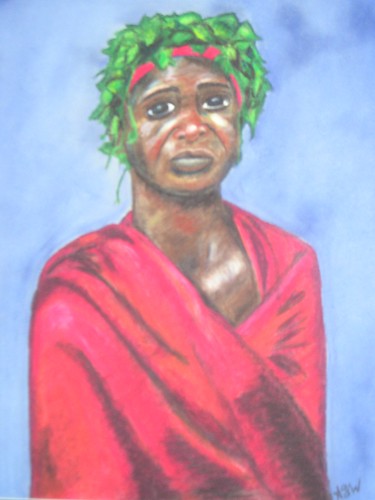
The bull was then led from the Cape Coast Castle, to where the fetish priests danced the night before. We waited with the children at the castle entrance. The bull finally came through the gate, led by a young man with a rope around the bulls neck and another in back, controlling a rope tied to the hind legs. The bull was forced into the gated area with the tree and the group of priests and priestesses. Men and women in red and black robes – calm & beautiful. Hundreds of people gathered around, climbing on top of the wall, on top of each other, to catch a glimpse of the sacrifice. One swift downward motion with the machete and the bull was on the ground. I was in the middle of the crowd. Slowly, the mob pushed me to the front (because I’m white and foreign and a woman). The guard at the gate opened the rod iron bars slightly and pulled me through. Into the courtyard. Blood everywhere. A small river on the ground. A priest cleaning the bloody machete in front of me. Men and women dressed in black and red with green wreathes atop their heads. The same picture i painted only 5 years ago, hanging in our living room. I was seeing it come to life.

I don't think it really hit me - how real it all was - until we walked back. Away from the crowd and the bull and the blood. It didn't really hit me until I turned around to see the fibrous red clump of particles resting peacefully on Rebecca's index finger. The "dirt" she had removed from the back of my shirt.

Love from Accra.

Monday, September 1, 2008

First Week of School and an African Sunrise

No, I have not fallen off the face of the planet!! I’m still here. still healthy. still happy. In typical African fashion, so much and relatively very little has happened in the couple of weeks since my last post.

For one thing, school has officially begun! We are entering into our second week of class and I’m still slightly uncertain about which courses I am taking, where they are held, and who is teaching them. I have spent the last two weeks crawling through the web of organized chaos that defines registering for courses at the University of Ghana.

The process requires a map of the campus, 6 passport photographs, and a whole lot of patience. In order to take courses in a particular department (economics, political science, history, etc) you have to physically walk to the department, fill out a form, attach a passport photo and sign your name next to each course title you are interested in taking. Sounds fairly simple, until you realize that you will be taking 6 classes in 4 departments and the course schedules don’t come out in any particular order. It’s kind of like a big scavenger hunt except, you don’t know exactly what you are looking for and aren’t quite sure about the rules.

The first week, I managed to make it to eight classes (missing two others because I couldn’t figure out where the classes were to be held). However, only one of the eight professors showed up. Apparently some were on strike and others felt they needed a longer holiday. I guess it happens every year. I should have known something was up when I began to notice that the only people in my classes were Ghanaian freshman (who, just like at any university, are expected to know nothing about anything) and “Obrunis”, meaning white people in Twi (who know even less).

Slowly however, things are falling into place and my schedule is shaping up to include: Literature of the Black Diaspora, International Conflict & Conflict Resolution, Refugees & International Relations, Colonial Rule and African Response, Twi, and Intro to African Drumming.

In an instant of impulsive insanity, I also agreed to join the cross-country team which means 5:30am runs 5 days a week. Training has only just begun but I have a strong feeling that this time in the morning will be my saving grace. There was a moment this morning during the last quarter mile when I felt invincible, like nothing could touch me. Maybe it was the endorphins, or the realization that I am in Ghana, or the feeling that if I pushed a little further I would be able to go on forever. Whatever the reason, in that moment, I could not imagine being anywhere else in the world missing that beautiful African sunrise.

It was like all of the good energy and happiness from every corner of the earth was wrapped up into a glowing circle peeking from behind a horizon lined with trees.

To steal the words of Mr. Mayer:
You should have seen that sunrise
With your own eyes
It brought me back to life…

Love from Accra!!!

Sunday, August 17, 2008

Chasing Waterfalls and Scaling Mountains

I have been in Ghana for three weeks now and the first day of school has been secretly creeping closer and closer. A number of EAP students decided to take one last trip before classes begin tomorrow (Monday). By the time our travel plans were adjusted and readjusted, we ended up with a group of seven adventures girls.

On Wednesday afternoon we took an STC bus from the center of Accra to Hohoe, a city just east of lake Volta. After an overly complicated taxi ride to the station and 5 hours on the bus, we arrived in Hohoe around 9pm. Arriving at night is never ideal, but we were able to check into a hotel, find food, and sleep 3 and 4 to a bed. The next morning, after consulting the Bradt guide, we set off for Likpe Todome, an ecotourism site whose hiking trail is known for its caves, waterfall, and view of the neighboring country, Togo.

We had been walking only a couple of minutes and just lost sight of the tourism office when our guide stopped in the middle of the path and waited for us to gather around him.
“See that stick?” He pointed to a lone stick protruding proudly from the top of a seemingly distant mountain. After searching for a second, we responded with excitement, thinking maybe it was some historical landmark.
“That’s where we are going.”
What?! We exchanged surprised glances and excited giggles. Thinking back, it was at this point that we should have realized it was not going to be an easy trek.

“The path to the caves involves a near vertical climb, and although ropes have been attached to the trees for support, its safety is questionable” - well, Mr. Brant is no liar. I don’t know why we were shocked when our guide expected us to clamber up into a dim, slippery cave. After reading the guidebook we should have known exactly what we were getting ourselves into.

After climbing up, into, around, and through a series of caves once used by the Bakuas people as hideouts, meeting places, and even prisons, we finally came to the bat cave. We were expected to shimmy down a ladder, through a hole - 3 feet in diameter, and into a dark underground cave, which houses a colony of bats. After the guide explained the process, we once again shot each other awkward glances of trepidation followed by a chorus of nervous giggles. Finally one of the girls spoke up,
“Um, is this part optional?”
“No.”
So the seven of us found ourselves crouched in a dim, somewhat damp cave with lamps on our heads and winged rats (aka bats) flying frantically from one side of the cave to the other. Needless to say, most of us were ready to climb back up the ladder after a lengthy 5 minutes of observation.

We spent the night at the Waterfall lodge owned by a friendly German couple. It is a beautifully secluded haven with a majestic vibe and a gorgeous view of the Wli waterfalls. The rooms were clean, there was toilet paper in the bathrooms, and mashed potatoes with meatballs were served for dinner. Leave it to the Germans to have everything in order.

The next morning we walked from the lodge to the bottom of the falls. After the adventures of the previous day, we learned not to take the Bradt descriptions lightly. The 2-hour hike to the base of the upper falls was going to be “arduous”, so we brought plenty of water, Neosporin, and band-aids. We were given walking sticks for the hike, which at first seemed like more of a hindrance than a help. However, it sprinkled on and off during the day and the steep, tiny path was extremely slippery. Towards the end, I was so thankful for something to lean on while jumping from the slick rocks onto the muddy path.

The view and the waterfall were of course absolutely stunning and the feeling of accomplishment was unprecedented. The seven of us worked as team lending each other a hand or shoulder for support, and encouraging one another after every fall (and there were many a stumble). It was definitely a bonding experience and I wouldn’t have wanted to do it with any other group of people. As dad would say, “Las Mujeres Fuertes!”

All in all it was a fantastic trip – I have the cuts, scratches, and bruises to prove it.

Love from Accra!

One of the many "near vertical" climbs

After rolling around in the bat caves, we finally made it to the waterfall

Tuesday, August 12, 2008

Cape Coast and Emlina Slave Castles

Cape Coast Slave Castle

Last week we traveled west of Accra to visit the Cape Coast and Elmina slave castles, which once served as the heart of the Trans-Atlantic slave route. The slave castles (even the name is an uncomfortable paradox) conjured an array of emotions among the group. I was left with a gut wrenching, awesome, exhausted confusion.

At one point we were led into a small room, 15ft. by 15 ft. with no light that trapped over 100 slaves at one time. Many of them suffocated. Their last breadths recorded by nail marks on the walls and ceiling, which today serve as both a memory and a warning.

My confusion was further fueled by the juxtaposition of beautiful white sand beaches and the dark, cold cement walls that so clearly separated freedom and confinement. From some parts of the castle, you can see the palms swaying lazily in the breeze of silent whispers from those who suffered only 200 years ago. The castle and surroundings seem to be far too handsome to have such a tragic history.

The governor’s quarters were located on the second floor of the castle – on one side of his bedroom, a view overlooking the Gulf of Guinea and the infinite Atlantic Ocean, free and uncontrolled. And through the other window, a view of the courtyard where the female slaves would line up -hoping that the months locked in a cell with the stench of feces, blood, and death would cause the governor to find them unattractive. The others were raped.

How is it possible that human beings were able to inflict such pain and humiliation on other human beings? It is said that almost 60 million slaves spent time locked in the castles over the period of only 200 years. More than half of them died before they were shipped to other countries to work as slaves.

I’m really not sure how to end this post, so I guess I will finish by repeating what was written on a plaque in the Elmina castle:

In everlasting memory
Of the anguish of our ancestors
May those who died rest in peace
May those who return find their roots
May humanity never again perpetrate
Such injustice against humanity
We, the living vow to uphold this


Love from Accra.

View From Cape Coast

View From Cape Coast Casle

Inside One Of The Cells

Elmina Slave Castle
View From Elmina Slave CastleInside Looking Out

Wednesday, August 6, 2008

Snaps from Kumasi

The market in Kumasi is the largest in all of West Africa!


Learning to weave in Kumasi


Friday, August 1, 2008

Akwaaba means welcome in Twi

I can’t believe I am finally here in Ghana. It all happened so quickly. I find it even harder to believe that I was still in India only a week ago. I miss India. I miss the intensity and stimuli. The busyness of the city. The hardness of the people. The “head wiggle”. Cows on the roads. I miss my duparta and being able to cover my head whenever I want to. I miss the modesty and the humbleness. I miss the things that became so familiar during the past 2 months – the challenges that I learned how to overcome. It’s funny how your perception of an experience changes once you have completed it. As ready as I was to leave, part of me really wishes I were back in India. Anther part of me wishes I were back in the US. And part of me is excited about the adventures that lie ahead.

I left Mumbai at 3am on Saturday morning, spent 6 hours in London, and finally arrived in the capital city, Accra around 8:30pm (local time) Saturday night. I was incredibly relieved to see an EAP (Education Abroad Program) student coordinator waiting for me since I wasn’t able to fly with the group. When I finally got to the International Student Hostel at the university, the other students were having dinner by candlelight – the power had gone out earlier in the day (and has gone out multiple times since). I am currently living with one of the Ghanaian Student Coordinators, Efua who has been a big help. The past few days have been jam packed with lectures, logistics, and fieldtrips. The University of Ghana campus is beautiful and lush – red dirt roads and all kinds of trees and shrubs. The campus is currently very quiet since school doesn’t begin till mid-August. I have to admit; I am definitely looking forward to a little bit more action.

On Sunday, we spent most of the day at the beach (which is super touristy) listening to live music, getting out of our seats only to dance or dip our toes in the water. We also had our first African dance lesson. Our teacher was an older man with glasses, a grayish beard, and a walking stick. He says he walks with a cane, but when he dances, “the cane falls away”. He spoke a little about the history and importance of African dance, explaining that it is about celebration and communication - about being able to let lose and have your soul transcend your body. It’s about being free to express yourself. Dancing is about family and acceptance. It was a blast (and a total workout!!)

On Wednesday we finally made it into the center of the Accra. Well kind of. We had a bus tour of the city. Accra is broken up into multiple parts depending in part by who colonized the area (i.e. Jamestown was colonized by the British). While the main roads were nicely paved there were many dirt alleyways lined with shanties (aka “low cost housing”). As in India there were some stark contrasts. There are many large buildings, center road dividers, and traffic lights, but then there are people living in their selling stalls, on the streets, in small door less shanties. There were children in the street barefoot and sometimes shirtless. There were women cooking and washing laundry only 100 yards from a fast food restaurant. Its odd to actually see the effects of globalization and development and to wonder how it is all affecting the informal markets.

Tomorrow we are traveling to Kumasi to learn more about Ghanaian festivals and funerals. We will return to Accra on Monday.

Miss everyone!! Love from Ghana!