Last week I got an email entitled “SOS Cameroon”. It was from a friend I met last summer in Cameroon. She is from the UK but is in setting up an NGO in Cameroon and has been there for the past couple of weeks. She was writing from the North West Province, where she had been stuck inside for the past four days. Her email went on to describe the events that had transpired over the past week...
"[...]a transporters strike which started in the commercial capital of Cameroon Douala, spread to the rest of the country, angry about the rise in petrol, and how this was effecting the prices of basic produce in the country. There was therefore no way to get back to Yaounde as no public transport was moving and people were attacking private vehicles for not showing respect for the strike."
"What people were now calling for was unclear……it could be a number of things, all of which I can kind of sympathize with. I mean we have corruption, unemployment, rising food prices, a not so democratic government, a pretty lame and ignorant President…I could go on. But the problem was that their protest wasn’t organized, didn’t have a clear message, but instead involved burning down building, looting shops and attacking innocent people on the street who tried to go about there daily lives. Where I am stuck in the North West has been in the worst…as this is the focal area of opposition to the Government."
"Today the North West was chaotic, the social unrest continued, and we started to seriously worry was Cameroon going to turn into the same trap as Kenya and Chad. 4 were killed, dozens arrested."
“People always question if civil war could develop in Cameroon, I never believe it could, the opposition is far too fractioned, but now I can’t say no, never, with such conviction.”
As i read her email my heart sank for two reasons: First, the most obvious, because a place that i had fallen in love with was being torn apart by violence. Second, because part of me wasn't all that shocked or surprised. Just another relatively stable, wealthy African country whose fate could change in the blink of an eye by violent government opposition. When did this idea cease to be shocking?
The email continues...
“As I sat listening to guns and teargas be fired yesterday afternoon, drinking tea in a kitchen with my Cameroon colleagues, it struck, that despite all the trails, tribulations, frustrations and fear of the past few weeks I have never wished to leave this country, I enjoy life here, I love the work I am trying to build up and I am lucky to have made some wonderful friends. It is with a little sadness that I make my preparations to leave Cameroon”
BBC has reported on the violent strikes and protests caused by increasing fuel prices:
Deadly Violences Wage in Cameroon (2/29/08) Cameroon head blames opposition (2/29/08)
Showing posts with label Cameroon. Show all posts
Showing posts with label Cameroon. Show all posts
Wednesday, March 5, 2008

Saturday, September 29, 2007
Laughing at Laundry in Cameroon
I have not washed my laundry in over three weeks. When I realized that I would literally have to wear my bathing suit under my dress this morning, I knew I just couldn’t put it off any longer. I begrudgingly went through the frustrating routine of turning my apartment upside-down in search of enough quarters for the washer and dryer. As I waited for the elevator to bring my laundry downstairs, I began complaining to myself about how long this whole process had already taken and I hadn’t even started yet. Then I suddenly, literally, laughed aloud at the memory of attempting to do laundry in Cameroon. What a mess…
…We had just returned to Yaoundé after spending time in Limbé, and arriving back at the peace house felt like coming home after a long journey. We were all excited to sleep in a familiar place, with familiar sounds and smells. Gabby and I settled into our room and about 10 minutes later we heard noises coming from the bathroom. The shower hose had somehow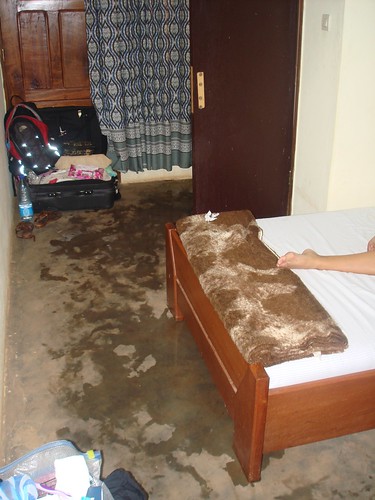 managed to turn itself on and began flooding our room! After we realized what was happening, turned off the water, and convinced ourselves that there was no such thing as a shower ghost, we decided to do our ‘laundry’ (after all, we were already wet and at this point in the trip, our clothes were really starting to smell).
We figured we couldn’t make anymore of a mess, so we proceeded to fill a bucket with soap and water. Somehow however, we managed to turn the small puddles that had gathered under our beds into what seemed like a full on river running across the room - It was quite a scene. Once we had done our best to get the dirt and stains out of our clothes, we hung everything to dry. Because we had been warned about bugs nesting in our underwear, the mental picture of which was fairly disturbing, we decided to hang our laundry inside our room rather than outside on the patio. We enthusiastically began what we called our “installation artwork”, which basically consisted of a tangled clothing line, crisscrossing over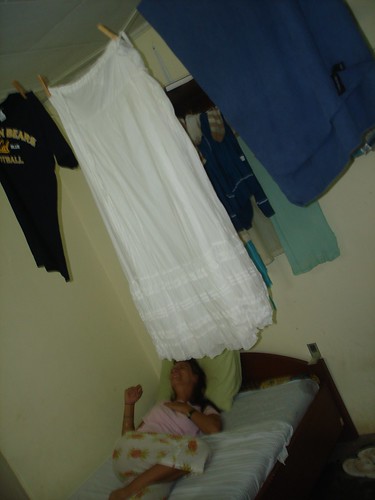 our beds. It took us an inordinate amount of time to figure out how to hang everything so that our clothes wouldn’t drip over us while we slept. But once we had finished, we were pretty proud of our contraption.
The following day we left early in the morning and were excited to return that afternoon to clean clothes. That is until we actually came back to find that although our clothes no longer smelled like the body odor of ten different people mixed together, they did reek of mildew - the stench of which is far worse when you are not use to it. Not to mention, everything was just as wet as it had been the night before. After we were told that we could use an iron to kill any bugs that decided to take shelter inside our clothes, we quickly moved everything outside. It was hilarious watching us iron - I have never seen people so intent on ironing every inch of their pants and paying special attention to the crotch…
…A laugh much needed - I guess there’s even beauty in doing the laundry.
…We had just returned to Yaoundé after spending time in Limbé, and arriving back at the peace house felt like coming home after a long journey. We were all excited to sleep in a familiar place, with familiar sounds and smells. Gabby and I settled into our room and about 10 minutes later we heard noises coming from the bathroom. The shower hose had somehow
managed to turn itself on and began flooding our room! After we realized what was happening, turned off the water, and convinced ourselves that there was no such thing as a shower ghost, we decided to do our ‘laundry’ (after all, we were already wet and at this point in the trip, our clothes were really starting to smell).We figured we couldn’t make anymore of a mess, so we proceeded to fill a bucket with soap and water. Somehow however, we managed to turn the small puddles that had gathered under our beds into what seemed like a full on river running across the room - It was quite a scene. Once we had done our best to get the dirt and stains out of our clothes, we hung everything to dry. Because we had been warned about bugs nesting in our underwear, the mental picture of which was fairly disturbing, we decided to hang our laundry inside our room rather than outside on the patio. We enthusiastically began what we called our “installation artwork”, which basically consisted of a tangled clothing line, crisscrossing over
our beds. It took us an inordinate amount of time to figure out how to hang everything so that our clothes wouldn’t drip over us while we slept. But once we had finished, we were pretty proud of our contraption.The following day we left early in the morning and were excited to return that afternoon to clean clothes. That is until we actually came back to find that although our clothes no longer smelled like the body odor of ten different people mixed together, they did reek of mildew - the stench of which is far worse when you are not use to it. Not to mention, everything was just as wet as it had been the night before. After we were told that we could use an iron to kill any bugs that decided to take shelter inside our clothes, we quickly moved everything outside. It was hilarious watching us iron - I have never seen people so intent on ironing every inch of their pants and paying special attention to the crotch…
…A laugh much needed - I guess there’s even beauty in doing the laundry.
Friday, September 7, 2007
Opportunity or Tradition?
On my flight from New York to Paris (en route to Douala), I sat next to a Man from Mali making a living selling African artwork in a New York based gallery. As he pulled out a primitive looking, wooden figure from under the seat in front of him, he explained how these sculptures had been passed down in families, from generation to generation for literally thousands of years. Talk about tradition. He told me about his wife, whom he quickly informed me he had ‘chosen himself’, meaning his marriage had not been arranged. He was part of the “new generation”. His father went to college in Paris and although his father’s marriage was arranged, he wanted his son to have a choice. His father was what he called a “forward thinker”.
We began discussing why he left Mali and how he had come to live in Paris and do business in New York. He described the “lack of opportunity” in Mali and began to recount his brother’s experience: His brother, who had studied economics, was offered a job in the U.S. working for the World Bank. Once his brother returned to Mali, he was given a ministerial position in the government. After experiencing the American systems, however, there were many things in Mali that he wanted to change. “The president didn’t agree, so my brother lost his job.”
He expressed how difficult it is to find a job in Mali, and even when you do, it can be taken away without a justifiable reason. I understood why he and his brother wanted to leave Mali, but I silently wondered, “what is it that makes them want to return?” Before I could ponder the question for too long, it was inadvertently answered - we began talking about children. Although he doesn’t have any yet, when I asked where he would raise a family, he unequivocally answered that his children would live in Mali by the age of 10. I was confused. I thought there weren’t enough opportunities. Why would he want his children to struggle the way he had? He explained that while he absolutely loves America and the opportunities available, it is the tradition that is most important to him. The family tradition. The “African way”.
At the time, I’m not sure I understood his words. When is tradition more important then opportunity and work? But after spending only two weeks in Cameroon, it is clear to me, what he meant by the “African way”. So much of African culture is deeply rooted in traditions. Tradition is who you are, where you come from, and to some extent where you are going. Opportunity, your job, is only what you do. So what if you have to choose? How do you decide which is more important? Success and opportunity or tradition?
In Cameroon, I met a young man, Jonas, on a bus from Bamenda to Buea. He had spent the weekend in Bamenda with his family and was returning to Buea for school on Monday. He was studying for most of the daylong bus ride - Biochemistry. He wants to go to medical school to become a doctor in America. Why America? I knew the answer before I asked the question - To “make money so he could support his family”. Would he come back to Cameroon? Of course. Not only does he want to help his family, he wants to serve the people in the country he loves. While Jonas ultimately wants to live with his family in Bamenda, he said it would be easier to find a job and make money in America.
In the U.S., for most, education can be directly converted into a job, which is then translated into money. In Cameroon, it’s not so simple. Educating yourself does not guarantee you employment. The unemployment rate in Cameroon is around 30% (2001 est.) and a large portion of those unemployed have college level degrees.
I realized, it’s not either opportunity OR tradition, it’s opportunity so that tradition. It’s about doing whatever you have to do to keep your family, your country, your tradition, and therefore yourself, alive. This not only solidifies my conception of African strength and resilience, it explains how tradition plays a large role in the development of these qualities.
Winston Churchill said, “A love for tradition has never weakened a nation, indeed it has strengthened nations in their hour of peril.”
Wednesday, August 29, 2007
“People, let me paint a picture”
By definition, first weeks of school are both intended and expected to be a little chaotic, but this particular first week has been really hectic, (and it’s only Wednesday). So when I decided to abandon my “non-isolationist” policy and listen to my ipod while waiting for class to begin, I didn’t feel guilty, even though I had just turned myself into another unapproachable college student. Besides, even if I had wanted to, I had no energy to string together a coherent sentence. Calculus tends to have that effect on me.
I haphazardly put on the mix a friend had made for me this past summer and turned up the volume so I couldn’t her myself think. The song "Around My Way" by Talib Kweli featuring John Legend came on. Literally within seconds I was wrapped up in another Cameroonian memory. I don’t know if it was the conviction of the lyrics, the fluidity of the rhythm, or the fervor in the voices. Or maybe it was the deliriousness that comes with derivatives. Whatever the cause, I was placed back into an exceptional state of mind - the same consciousness I experienced on our last Sunday in Cameroon…
It had been a long time since I’d been to mass, or any kind of religious services for that matter - with the exception of weddings, bar mitzvahs, and more recently, funerals. While I don’t practice a particular religion or faith, I love sharing meaningful traditions and practices that allow me a deeper understanding of my friends and their beliefs. So when Florentine asked us to join her at Church the Sunday before we left Yaoundé, I was more than excited to attend. The service was held in a simple, unadorned one-room cement building just down the road from The Peace House. Plastic 'patio furniture' chairs were arranged in rows across the width of the room. As the service began, I felt as though my mind was compensating for the fact that I don’t understand French, because I noticed the rest of my senses were unusually acute.
It was absolutely beautiful - Perfect in its “imperfection” and genuine in its purity. It was enlightening to see how the service not only fostered a sense of community, but also how it was very much about the individual and his or her relationship with God. At one point, everyone was asked to pray - To ask the lord to “come and be present”. I did not find this request particularly uncommon, but as I prepared myself for the recitation of a blessing or prayer, I was stunned at the sudden, sporadic eruption of voices that surrounded me. If I hadn’t known I was in church, I would have thought I was in the middle of a crowded market. The loud chorus of voices was confusing - everyone shouting different things at different times with such dedication and intensity. I looked again around the room, at the men and women standing, heads lifted upward (rather than bowed), arms reaching out, and I realized that each of these people were speaking directly to God, with their own words and in their own way.
The first time I closed my eyes, the sounds actually made me nervous. It felt like the voices were surrounding me. Suffocating me. Taking up a physical presence in the room. I felt like I had to hold my breath because there was no space or oxygen left for me. I felt out of control, unprepared, and in some strange way, vulnerable. I took in a deep breath and as I exhaled, I let go. As I let go of the fear and anxiety, I held on to the passion in the words around me. The voices that had before been closing in on me began to lift me. I couldn’t help but smile. I felt weightless. Once God had “come and was present,” the ‘shouting’ turned into singing, which was of course accompanied by clapping and dancing around the room so that we could greet one another. And when I say greet, I don’t mean a handshake and quick hello, but hugs, kisses, and dancing with our neighbors, young and old. I have a great picture of this ‘greeting’ in my head. A celebration is probably a more accurate description - A celebration of life, love, and friendship. It’s a picture that will always make me smile, and that I’ll always have time to remember - even during weeks like this one.
Saturday, August 25, 2007
Presence is profound
Last weekend at a Cal Corps conference, Dr. Antwi Akom (one of the most inspired and inspiring individuals I have ever met) spoke about community service. He made two main points that have since been resonating in my head. He began by emphasizing that if your intent is to really make a substantial, sustainable difference in a community, you must make a commitment to serve. Volunteering should be thought of as “community commitment” rather than community service. When it comes to initiating change, good intentions can often do much more harm than actual good. While university students are often busy with classes, extracurricular activities, and social events, many of us are involved with some kind of community service activity, but very few of us fully comprehend the impact on our community - not only when we ‘show up’ but also when we don’t.
Kim Turner, the ‘Kids Rock’ after school program coordinator at Hoover Elementary School in Oakland, CA, gave an example of when good intentions that lack commitment can be counterproductive. As a component of the ‘Kids Rock’ program, elementary school children are paired with college student mentors. While encouraging and reliable role models have positively affected many of the children at Hoover, Ms. Turner described instances when mentors must have decided that something was more important than their ‘community service project’ because they just didn’t show. No one should have to be put in the position of explaining why to a 3rd grade child who is waiting for his mentor.
Listening to her speak, I kept thinking about Lumière, a four-year-old girl at The Dan and Sarah Foundation (an organization which cares for orphaned and disadvantaged children in Cameroon). I was placed there to volunteer for two days during our stay in Yaoundé. While I know the children enjoyed playing with us and our help with cooking was greatly appreciated, I couldn’t help but think - playing with these children for an afternoon or two would probably have very little, if any, effect on their lives. By the second, and last day of our volunteer work, I had become emotionally attached to Lumière (her name meaning ‘light’ in French), who had permanently fastened herself to my hip. “Are you coming back tomorrow?” she asked. I shook my head. No. I wouldn’t be coming back tomorrow, or the day after. The smile on her face disappeared and she clung tightly to my leg. I bent forward to give her one last hug. She kissed my cheek and waved goodbye as she ran off with her friends.
As our bus drove away from the orphanage, my stomach tightened. Not because it was hard to leave the children, which it was, but because they seemed so used to having to say goodbye. No child should be used to having people suddenly come into their lives, give them all of the attention and love in the world, and then just as suddenly leave. These kids don’t expect commitment, and while I realize it’s a coping mechanism that is both important and necessary, the loss of this kind of childhood innocence is difficult for me to accept. Which brings me back to the idea of asking, ‘how important is this cause to me and what kind of commitment am I willing to make?’ which is a question I’m still struggling to answer.
The second point that Dr. Akom made, was that in order to really understand someone from a different background we must first “decolonize our own minds.” In order to make a difference in someone else’s community, you must recognize that you are only a visitor. “You are not the experts, they are”. Your mind must be cleared of any and all preconceptions. The only way to understand and assess a community’s needs is to listen to those who are actually facing the challenges every day.
When you are a visitor in a foreign neighborhood, community, or even country, it’s important to know how the community is viewing you. In order to do this, Dr. Akom began asking people from underprivileged communities what questions they had for strangers coming into their community to do research/ service. These are some of the common questions the community had for volunteers…
Whose research is it?
Whose interest does it serve?
Who is benefiting?
How will the results be disseminated?
Is your own spirit clear?
And finally…
Where is your heart?
When he finished reading the list, he urged us to "remember that presence is profound.”
 The Dan & Sarah Foundation in Yaounde, Cameroon.
Photo taken on Thursday, June 21st, 2007
Kim Turner, the ‘Kids Rock’ after school program coordinator at Hoover Elementary School in Oakland, CA, gave an example of when good intentions that lack commitment can be counterproductive. As a component of the ‘Kids Rock’ program, elementary school children are paired with college student mentors. While encouraging and reliable role models have positively affected many of the children at Hoover, Ms. Turner described instances when mentors must have decided that something was more important than their ‘community service project’ because they just didn’t show. No one should have to be put in the position of explaining why to a 3rd grade child who is waiting for his mentor.
Listening to her speak, I kept thinking about Lumière, a four-year-old girl at The Dan and Sarah Foundation (an organization which cares for orphaned and disadvantaged children in Cameroon). I was placed there to volunteer for two days during our stay in Yaoundé. While I know the children enjoyed playing with us and our help with cooking was greatly appreciated, I couldn’t help but think - playing with these children for an afternoon or two would probably have very little, if any, effect on their lives. By the second, and last day of our volunteer work, I had become emotionally attached to Lumière (her name meaning ‘light’ in French), who had permanently fastened herself to my hip. “Are you coming back tomorrow?” she asked. I shook my head. No. I wouldn’t be coming back tomorrow, or the day after. The smile on her face disappeared and she clung tightly to my leg. I bent forward to give her one last hug. She kissed my cheek and waved goodbye as she ran off with her friends.
As our bus drove away from the orphanage, my stomach tightened. Not because it was hard to leave the children, which it was, but because they seemed so used to having to say goodbye. No child should be used to having people suddenly come into their lives, give them all of the attention and love in the world, and then just as suddenly leave. These kids don’t expect commitment, and while I realize it’s a coping mechanism that is both important and necessary, the loss of this kind of childhood innocence is difficult for me to accept. Which brings me back to the idea of asking, ‘how important is this cause to me and what kind of commitment am I willing to make?’ which is a question I’m still struggling to answer.
The second point that Dr. Akom made, was that in order to really understand someone from a different background we must first “decolonize our own minds.” In order to make a difference in someone else’s community, you must recognize that you are only a visitor. “You are not the experts, they are”. Your mind must be cleared of any and all preconceptions. The only way to understand and assess a community’s needs is to listen to those who are actually facing the challenges every day.
When you are a visitor in a foreign neighborhood, community, or even country, it’s important to know how the community is viewing you. In order to do this, Dr. Akom began asking people from underprivileged communities what questions they had for strangers coming into their community to do research/ service. These are some of the common questions the community had for volunteers…
Whose research is it?
Whose interest does it serve?
Who is benefiting?
How will the results be disseminated?
Is your own spirit clear?
And finally…
Where is your heart?
When he finished reading the list, he urged us to "remember that presence is profound.”
The Dan & Sarah Foundation in Yaounde, Cameroon.Photo taken on Thursday, June 21st, 2007
Wednesday, August 22, 2007
Brother from another mother
I’ve always secretly wanted an older brother. Someone to worry and care about me, someone to fight with (in the most loving sense of the word), and someone to protect me even when I don’t think I need protecting (which is probably more often than not). I never imagined however, finding a brother on the other side of the world.
After traveling for 3 straight days, arriving at a foreign airport that was both confusing and overwhelming, and getting stopped in the middle of the night for a “visa/ passport check”, home felt a million miles away. Just as my mind began to wander to the awful “what if” scenarios, we finally arrived at the hostel in Yaoundé.
As I approached the front steps, wide-eyed and a little nervous, the women standing at the door came forward. I found myself suddenly and completely enfolded by two strong but gentle arms and every muscle in my body began to relax. It was at that moment, being embraced by a women I had never met, but feeling the love of a universal mother, sister, and grandmother, that I knew I did not need to be nervous or afraid. After a long and tiring journey, I was finally “home”. It quickly became apparent that the welcoming nature of the women at The Peace House was no coincidence or exception.
After having been briefed by the US embassy on the dangers of traveling alone in Cameroon, some of the Cameroonian students offered to escort a few of the American girls to the market. There were people and taxis’ everywhere, and as we did our best to dodge them while still avoiding the treacherous gutters that lined the roads, I got the distinct, intuitive feeling that someone was following me. My grip on my bag automatically tightened as I quickly glanced back. I was relieved to find that it was one of my new Cameroonian friends who had been following so closely. He gave me a look that has since been burned into my memory. A look that said, “Don’t worry; I will take care of you.”
From that day on, these men were not only our peers and friends; they were our shadows, our bodyguards, and sometimes even our fashion experts. Everywhere we turned they were there protecting us – making sure that we weren’t getting into trouble. They took care of us not out of obligation, but out of genuine affection and respect. We shared an instant bond that I have never experienced. How was it possible that we were already so close? “You are my sister and I am your brother” was the only possible explanation I received or needed. We are family because we are human beings - we share a world, a history, and a vision.
Time and time again, I was welcomed into the homes of parents and grandparents, and time and time again, I was treated as family. I have never witnessed such unconditional giving. Sit down - I can stand. Eat - There’s always enough. Drink – you must be thirsty. Come in - you’re always welcome. While traveling throughout Cameroon, my light skin, hair color, and height, definitely made me stand out. And while I was often observed with strange and contorted facial expressions, the confusion disappeared as soon as I smiled. The smiles, waves, and occasional “peace signs” I received in return told me that no matter my background or nationality, as long as I showed acknowledgement and respect, I was welcome.
Although Americans don’t usually have a reputation of being very welcoming (among many other things), I hope that some day it will become clear to us that we do share a world and a family that is larger than our immediate community - A family that is capable of great things and although doesn’t necessarily need our help, deserves our support.
“Compassion can be put into practice if one recognizes the fact that every human being is a member of humanity and the human family regardless of differences in religion, culture, color, and creed. Deep down there is no difference."
~ Dalai Lama
My self-challenge: To welcome and acknowledge a 'stranger' as a member of my family.
 "Family Photo" with Rene's family in Bamenda, Cameroon.
Photo taken on Friday, June 15th, 2007
After traveling for 3 straight days, arriving at a foreign airport that was both confusing and overwhelming, and getting stopped in the middle of the night for a “visa/ passport check”, home felt a million miles away. Just as my mind began to wander to the awful “what if” scenarios, we finally arrived at the hostel in Yaoundé.
As I approached the front steps, wide-eyed and a little nervous, the women standing at the door came forward. I found myself suddenly and completely enfolded by two strong but gentle arms and every muscle in my body began to relax. It was at that moment, being embraced by a women I had never met, but feeling the love of a universal mother, sister, and grandmother, that I knew I did not need to be nervous or afraid. After a long and tiring journey, I was finally “home”. It quickly became apparent that the welcoming nature of the women at The Peace House was no coincidence or exception.
After having been briefed by the US embassy on the dangers of traveling alone in Cameroon, some of the Cameroonian students offered to escort a few of the American girls to the market. There were people and taxis’ everywhere, and as we did our best to dodge them while still avoiding the treacherous gutters that lined the roads, I got the distinct, intuitive feeling that someone was following me. My grip on my bag automatically tightened as I quickly glanced back. I was relieved to find that it was one of my new Cameroonian friends who had been following so closely. He gave me a look that has since been burned into my memory. A look that said, “Don’t worry; I will take care of you.”
From that day on, these men were not only our peers and friends; they were our shadows, our bodyguards, and sometimes even our fashion experts. Everywhere we turned they were there protecting us – making sure that we weren’t getting into trouble. They took care of us not out of obligation, but out of genuine affection and respect. We shared an instant bond that I have never experienced. How was it possible that we were already so close? “You are my sister and I am your brother” was the only possible explanation I received or needed. We are family because we are human beings - we share a world, a history, and a vision.
Time and time again, I was welcomed into the homes of parents and grandparents, and time and time again, I was treated as family. I have never witnessed such unconditional giving. Sit down - I can stand. Eat - There’s always enough. Drink – you must be thirsty. Come in - you’re always welcome. While traveling throughout Cameroon, my light skin, hair color, and height, definitely made me stand out. And while I was often observed with strange and contorted facial expressions, the confusion disappeared as soon as I smiled. The smiles, waves, and occasional “peace signs” I received in return told me that no matter my background or nationality, as long as I showed acknowledgement and respect, I was welcome.
Although Americans don’t usually have a reputation of being very welcoming (among many other things), I hope that some day it will become clear to us that we do share a world and a family that is larger than our immediate community - A family that is capable of great things and although doesn’t necessarily need our help, deserves our support.
“Compassion can be put into practice if one recognizes the fact that every human being is a member of humanity and the human family regardless of differences in religion, culture, color, and creed. Deep down there is no difference."
~ Dalai Lama
My self-challenge: To welcome and acknowledge a 'stranger' as a member of my family.
"Family Photo" with Rene's family in Bamenda, Cameroon.Photo taken on Friday, June 15th, 2007
Sunday, August 19, 2007
The beauty that is Cameroon
It’s been 69 days since I first arrived at Douala airport. Almost 1668 hours since I boarded a bus that night, that would take me to Yaoundé (or so I hoped). And its been approximately 100,000 minutes since I first began a journey that would not only open my eyes, but also my heart.
Not a day has past since I left Cameroon, that I have not closed my eyes and wished to be back in the “armpit of Africa”. As I sit here and repeat this ritual to which I have been accustomed, I am overwhelmingly engrossed in my memory – the moist heat, the orderly chaos of people and taxis’, the sound of palpably genuine prayer, the weight of a sleeping child in my arms, the loving touch of a grandparent, and the welcoming smile of a stranger. As my body is overpowered by my memory, I am forced to open my eyes and confront the emptiness in my chest. My mother’s hope and fear was actualized - I left a piece of my heart in Cameroon.
It hasn’t been until now, that I can effectively look back on my trip to Cameroon and begin to really understand how much I have been impacted by the immersion and each of the people I met over the two week period in June. I haven’t been able to really discuss the trip in detail for two reasons: firstly, out of fear that words would be a completely inadequate means of conveying my experience or capturing the beauty of Cameroon and my family there, and secondly, because I learned very quickly that I have little patience for ignorance and blind judgment.
My second night back from Cameroon, a friend of the family made the statement, “I imagine it would be hard not to feel superior in Africa”. While I knew he didn’t realize the weight of his words, it took the strength of every bone in my body to swallow back the scream that was rising in my diaphragm. I mustered up enough patience to explain to him, that for the past two weeks I had never once felt superior but instead I felt completely inadequate. I had witnessed the kind of strength, resilience, determination, and spirit, that I never imagined could be possessed by a single human being: A young man on the bus who was willing to give anything to complete his education in order to be a successful doctor and “save lives”, an orphan who is confident that she will one day be the president of Cameroon, and a former street child who has suffered more pain than a heart should ever have to hold, yet is not only helping to educate and raise his sisters, but is fulfilling a dream to inspire others through his own passion.
Did I feel superior? No. I felt guilty and ashamed. Ashamed of the wealth and luxury that I, as an American and a European citizen, have been granted, due in part to the history of exploitation of African people and resources. As the fire inside me began to finally extinguish itself, I realized that I wasn’t ready to try to address people’s ignorance or their prejudices. I also wasn’t ready to begin to sort through my own. After two months however, I have finally had time to let the experience soak in and I would like to dedicate the first entries of this blog to try and share some of my memories of the beauty that is Cameroon.
While we all have first impressions and often times make quick and uneducated judgments, I would like to challenge myself and anyone else who reads this, to take just an extra minute to look for and be open to the beauty. Especially of a place or a people unseen.
Subscribe to:
Posts (Atom)